
Podcasts
St. Lawrence Victory with Roger Sarty
Subscribe: Apple Podcasts | RSS | Spotify | Stitcher
The St. Lawrence River and the Gulf of St. Lawrence have long been crucial waterways connecting central Canada to the Maritimes and Europe. In the Second World War, German submarines threatened this vital supply line, especially in late summer 1942. This was the year from hell for the Royal Canadian Navy. Although America’s entry into the war would eventually help the Allies achieve total victory it added further burdens to an already stretched fleet. Early accounts of the war in the St. Lawrence described an embarrassing Canadian defeat. In February 1972, The Canadian Magazine published an article describing it as “The Second World War battle we lost at home” and “the war story our leaders kept quiet”. Thirty years of research has shown that nothing could be further from the truth. The Royal Canadian Navy and Royal Canadian Air Force mounted a successful defence despite restrictions imposed on two growing services locked in a global war. Furthermore, Prime Minister Mackenzie King’s government shared losses openly in order to galvanize support for their wartime policies.
The Battle of the St. Lawrence was the only battle of the 20th century to take place in Canadian boundaries. Furthermore, it was the only Second World War campaign totally under Canadian control. As our guest, Roger Sarty, notes, the campaign was crucial to supplying Britain and the Allied forces poised for the liberation of northwest Europe.
Support Canada’s Juno75 Commemorative Campaign!
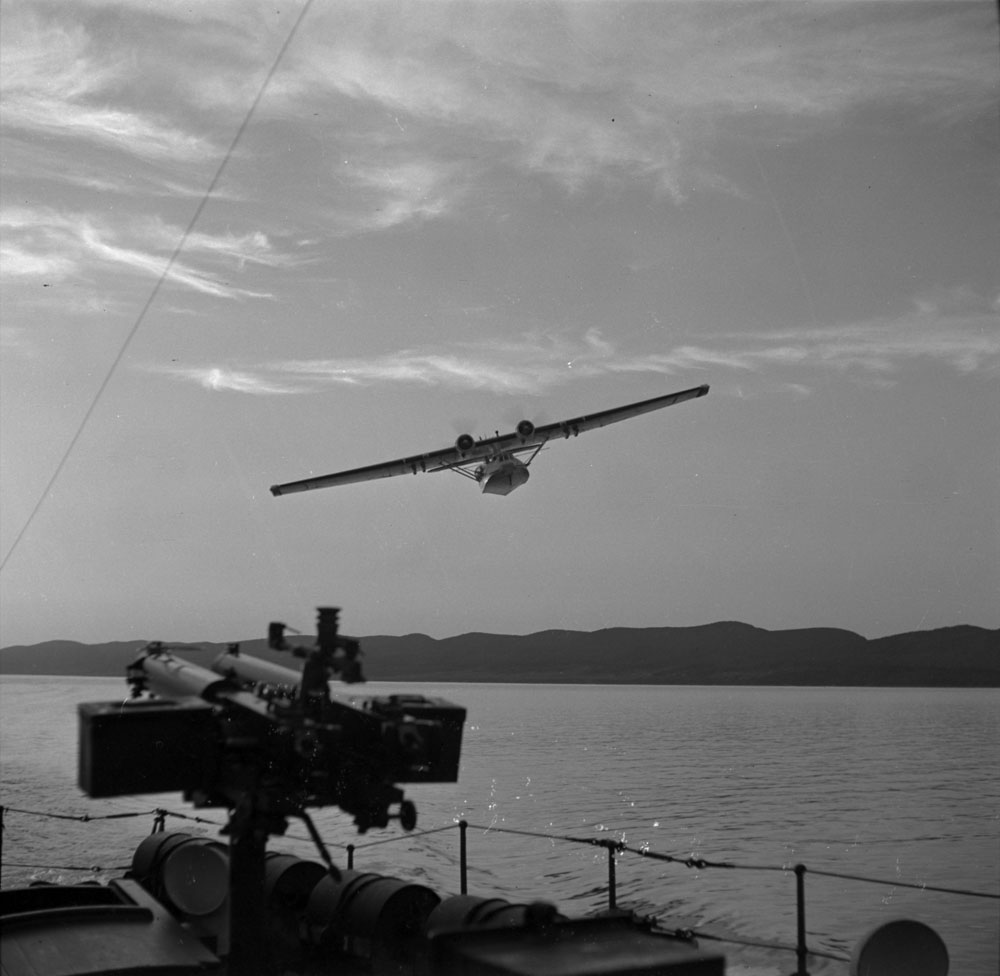
Consolidated Canso or Catalina flying boat from the after deck of a Fairmile, showing the vessel’s twin .50 calibre machine guns and depth charges, at Gaspé, June 1943 (LAC, e010859223).
Time Stamps
4:01 Getting the Project Off the Ground
5:20 1942: The Year From Hell for the RCN
7:22 Building the RCN and RCAF, 1939-1942
9:19 The Shifting Priority of the St. Lawrence
11:45 Anti-Submarine Warfare Tactics and Equipment
18:05 The First Attacks in the St. Lawrence
19:00 On A Shoestring
26:11 Managing Public Opinion
28:50 The Decision to Close the St. Lawrence
32:13 The Tragedy of the SS Caribou
39:20 Into 1943 and 1944
43:32 Victory in the St. Lawrence
Guest Biography
Roger Sarty is professor of naval, military, and Canadian history at Wilfrid Laurier University. In the 1980s and 1990s, he worked on the official histories of the Royal Canadian Air Force and Royal Canadian Navy as an historian at the Department of National Defence. In the early 2000s, he played a managing role in the redesign of the current Canadian War Museum in Ottawa.
Notes
The following links offer more information on the topics discussed in this episode:
Events
Submarines Attack in the St. Lawrence
British Commonwealth Air Training Plan
Squadron Leader Small’s Attack on U-754
Weapons & Formations
People
Credits
Juno Beach & Beyond is hosted and edited by Alex Fitzgerald-Black, the centre’s Digital Projects Coordinator.
Mackenzie King’s speech to British Parliament from the British Pathé YouTube channel: https://www.youtube.com/watch?v=6SlEvclY5LE&t=48s
Artillery firing sounds from the CBC News: The National YouTube Channel: https://www.youtube.com/watch?v=RsCSQ4uWR1Y
Female veteran’s voice (Eileen Green, née Short) Courtesy of The Memory Project, Historica Canada: http://www.thememoryproject.com/stories/383:eileen-green-nee-short/
Winston Churchill’s “Finest Hour” speech from Jonathan Thomas’s YouTube channel: https://www.youtube.com/watch?v=jB5wZtV1MWM
Spitfire sound effect from Jason Kirby’s YouTube channel: https://www.youtube.com/watch?v=xgZI4tAoMN0
Dramatic Interlude by Alexander Nakarada | https://www.serpentsoundstudios.com
Music promoted by https://www.free-stock-music.com
Attribution 4.0 International (CC BY 4.0)
See more

Donate
to the JBC
As a primarily privately-funded museum, it’s our donors who have made the dream of the Juno Beach Centre a reality.
Learn more about the unique initiatives you can help fund or make a gift to our general fund today to honour the legacy of Canada’s Veterans and ensure their story continues to be told.