
Visit the Juno Beach Centre
The Juno Beach Centre is Canada’s Second World War museum and cultural centre located in Normandy, France. The Centre pays homage to the 45,000 Canadians who lost their lives during the War, of which 5,500 were killed during the Battle of Normandy and 381 on D-Day. Opened in 2003 by veterans and volunteers with a vision to create a permanent memorial to all Canadians who served during the Second World War, the Centre’s mandate is to preserve this legacy for future generations through education and remembrance.


Admission Prices 2026
Methods of payment cash in Euros or CB. Individual tickets can be purchased in-person or online. Free for Second World War Veterans and widows, war disabled and accompanied children under 8.
Note that bunkers are only accessible as part of the guided tour offered by the Juno Beach Centre. Spaces are limited, more information below.
* Reduced rate is valid for: children from 8 to 18 years old, students, teachers, unemployed persons, military members and veterans , those accompanying handicapped persons, Premium Explore Normandy Pass, Pierre & Vacances customer, Gites de France customer, Canadians Forces 1 Card, Inolya club members, Brittany Ferries passenger (Upon presentation of a proof).
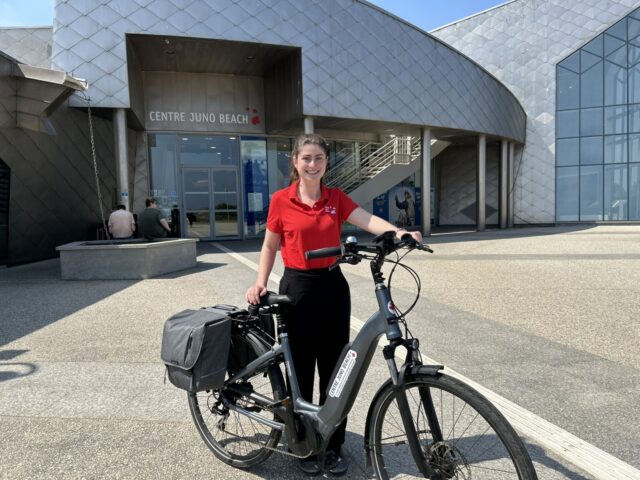
† With the presentation of proof of travel taken on an SNCF train to a station in Normandy, on a regional Nomad – Kéolis bus, or by bicycle.
‡ Maximum 2 adults and 3 children over 8 years of age.
See General Sales Conditions.
Group reservations can only be made by phone (+33 2 31 37 32 17) or by emailing us at resa@junobeach.org.
Download Group Brochure
§ By reservation. One free space is given per 20 paid. Guides and chauffeurs are free. See General Sales Conditions.
Note that prices for School Groups w/ Explore Juno will increase in 2027 to 8,50€/student (or 7,50€ with low carbon rate).
See our full Visitor Regulations/Vistor Policy here.
Group reservations can only be made by phone (+33 2 31 37 32 17) or by emailing us at resa@junobeach.org.
Download School Group Secondary Brochure
Download School Group Primary Brochure
|| By reservation. For school groups with more than 30 students, adjustments must be made to the schedule. Please contact us for further information. See General Sales Conditions.
What's On At the Museum?
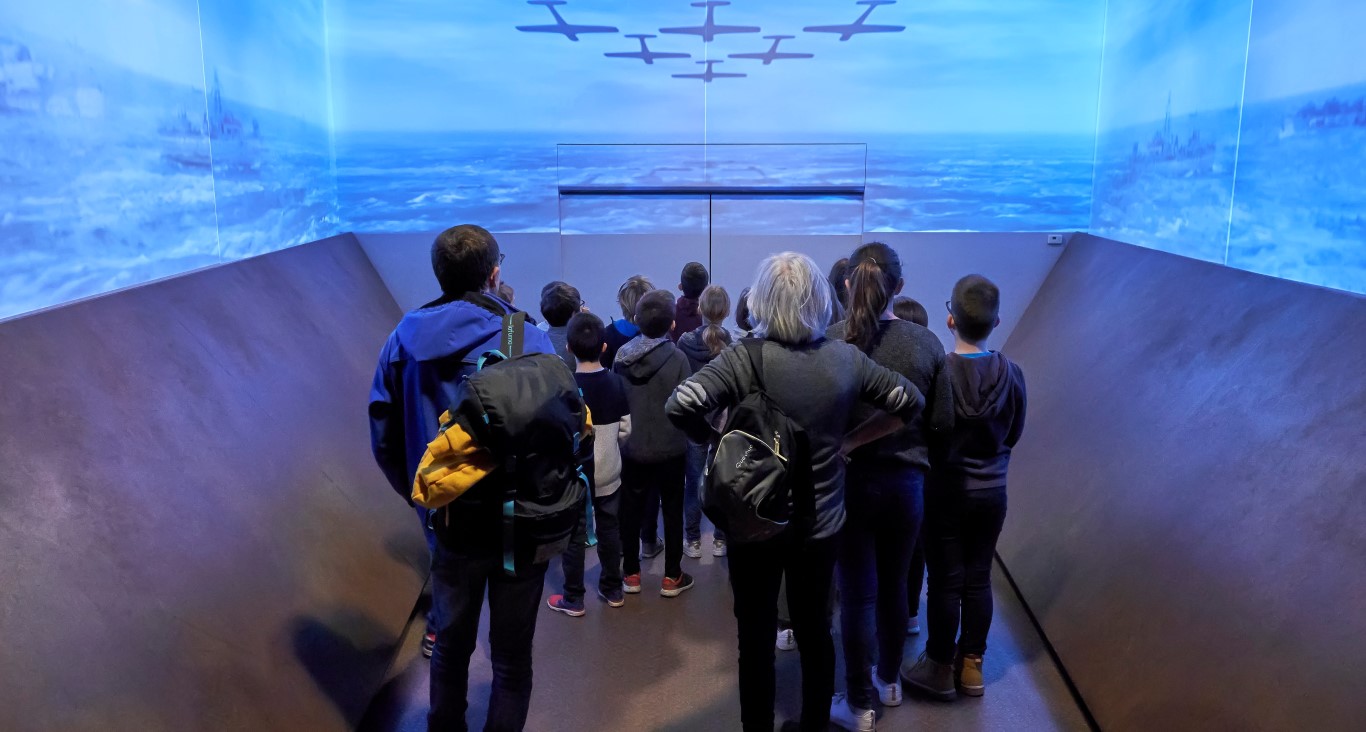
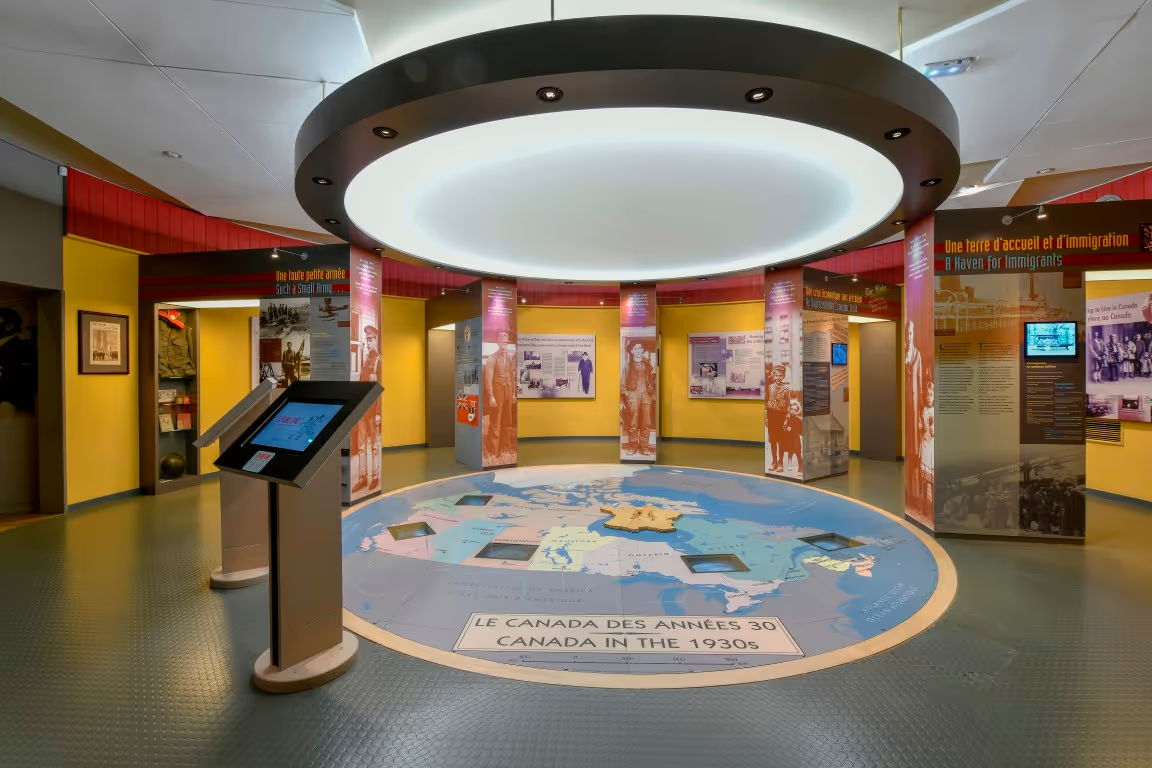
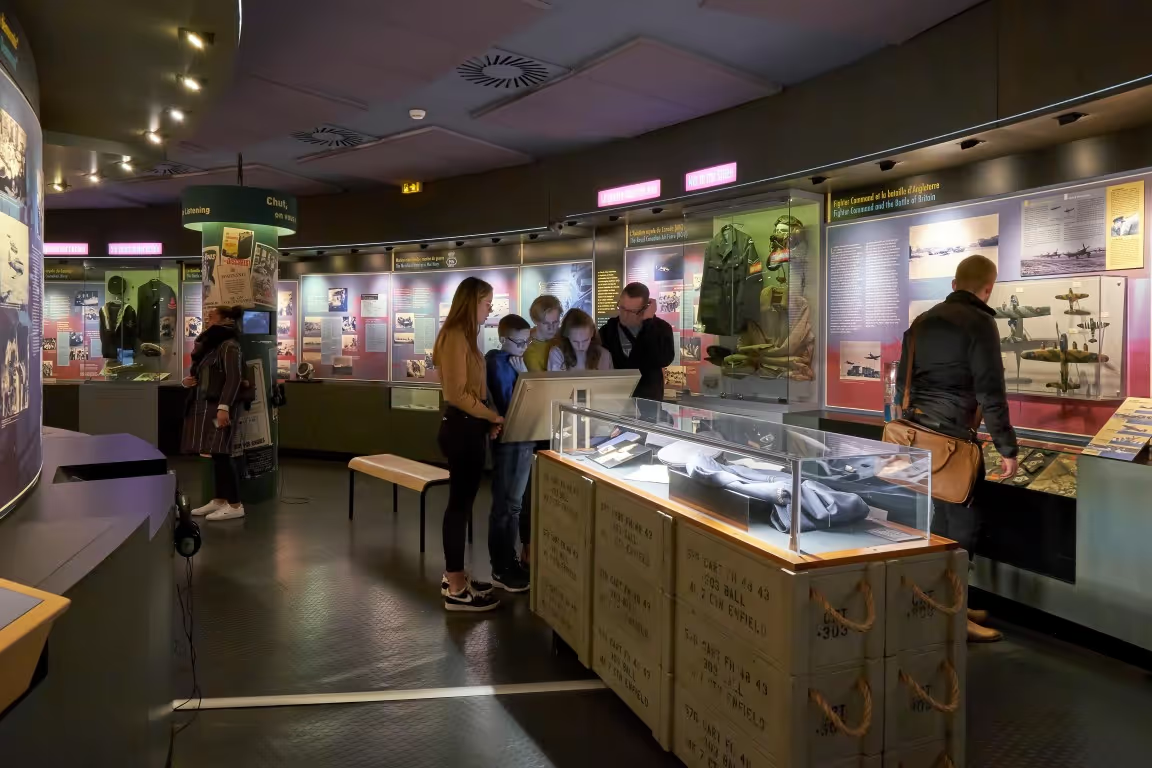
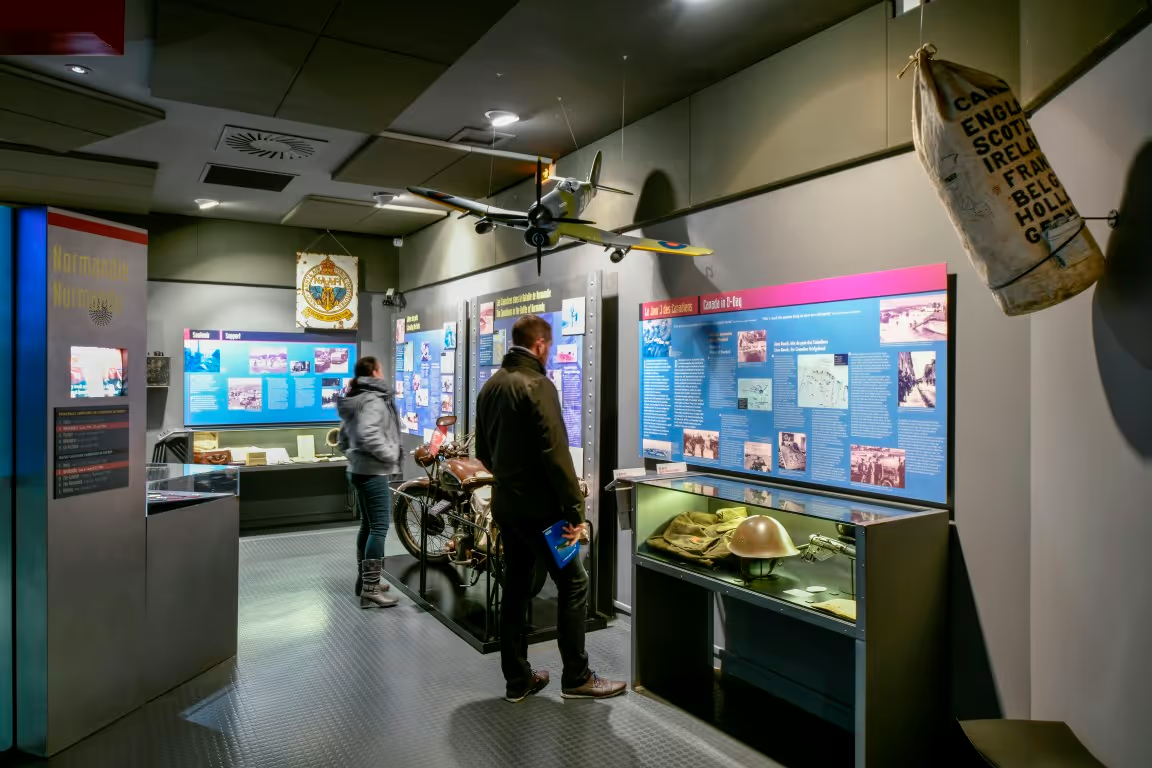
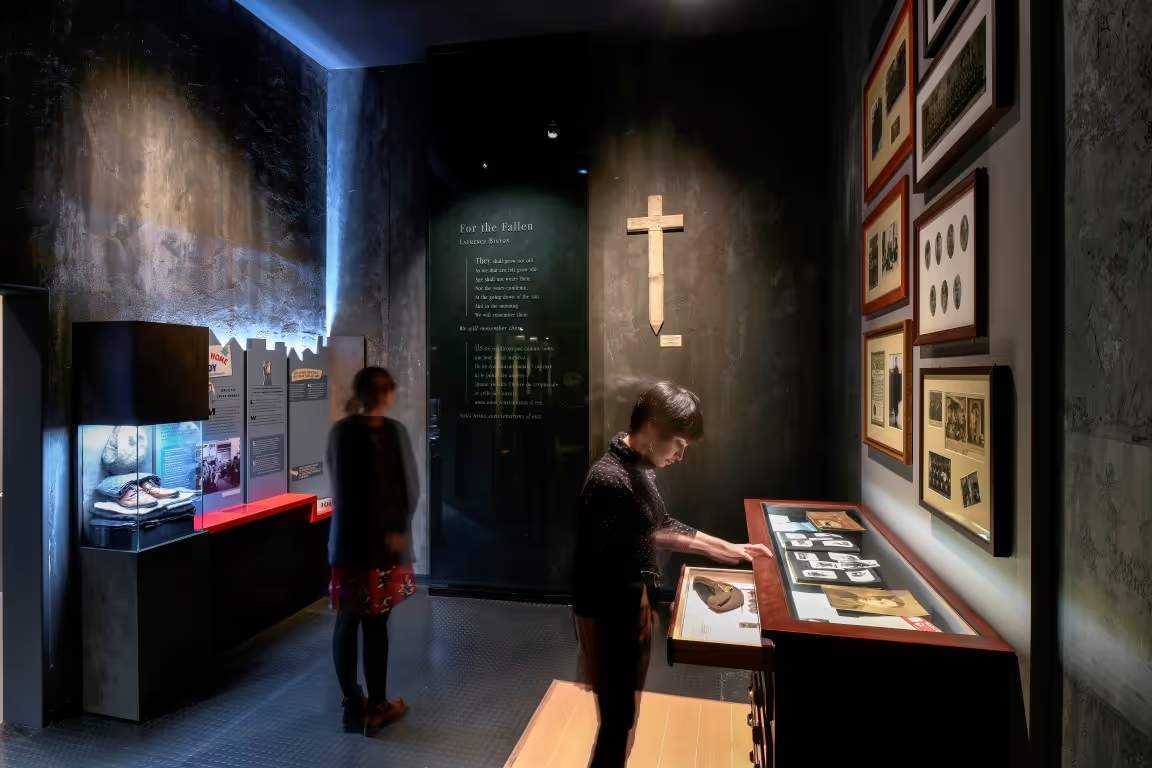
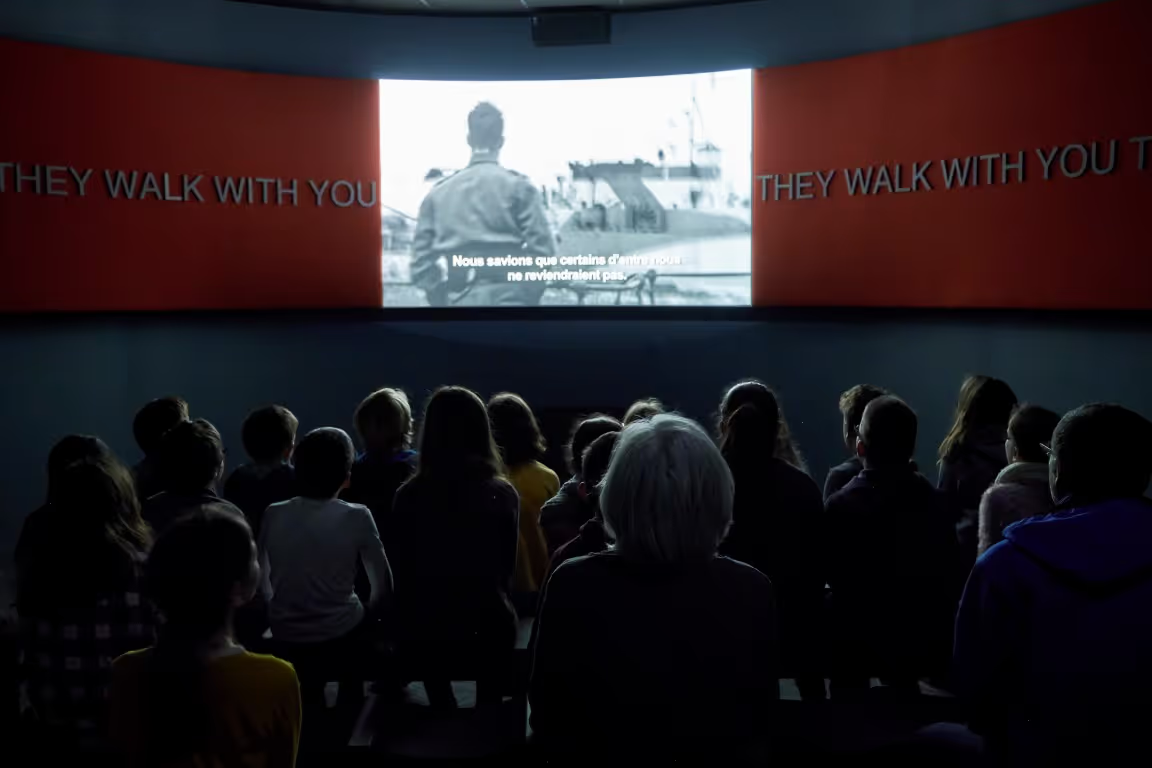
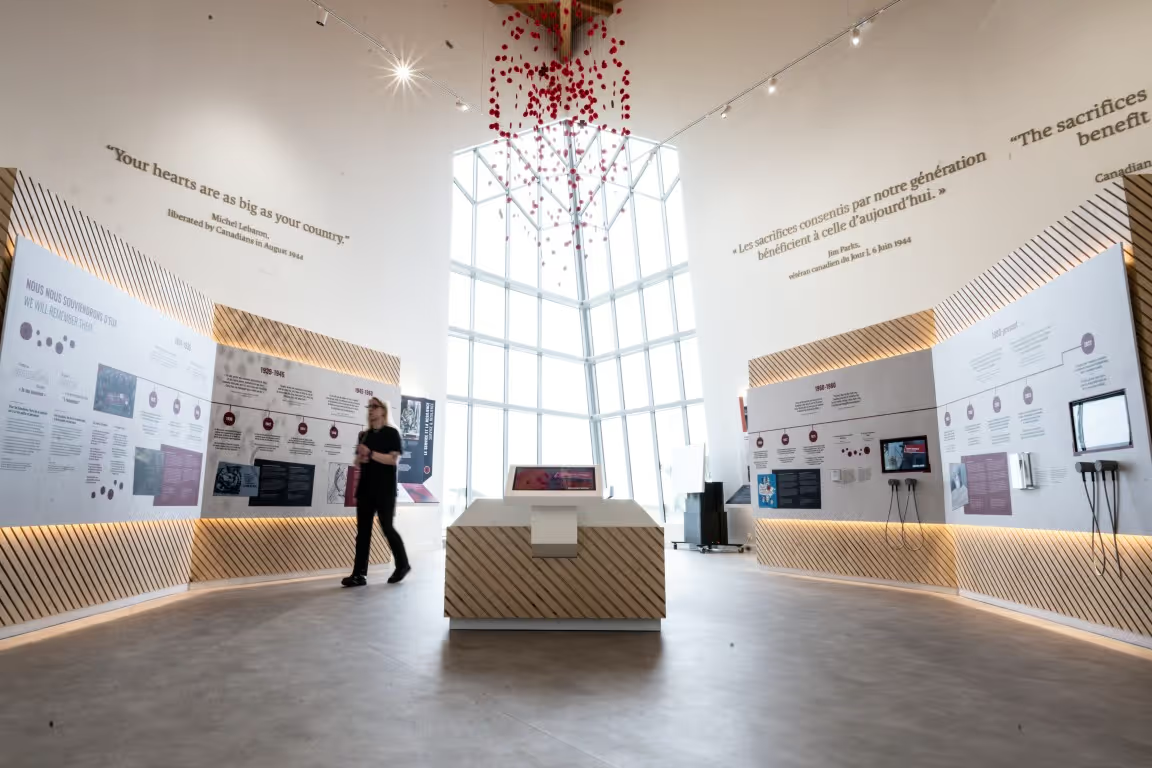
The Juno Beach Centre offers visitors a better understanding of the contribution that Canada made to the Second World War. At the same time, by showcasing contemporary Canada, the Centre allows visitors to learn more about Canadian values and culture. The permanent and temporary exhibits alternate between areas of emotion, reflection, discovery, and remembrance, eliciting the visitor’s participation. The temporary exhibitions presented in the exhibition room, in the museum lobby, or online deepen and extend the visitor’s experience.
Tours & Activities
Juno Park & Guided Bunker Tours
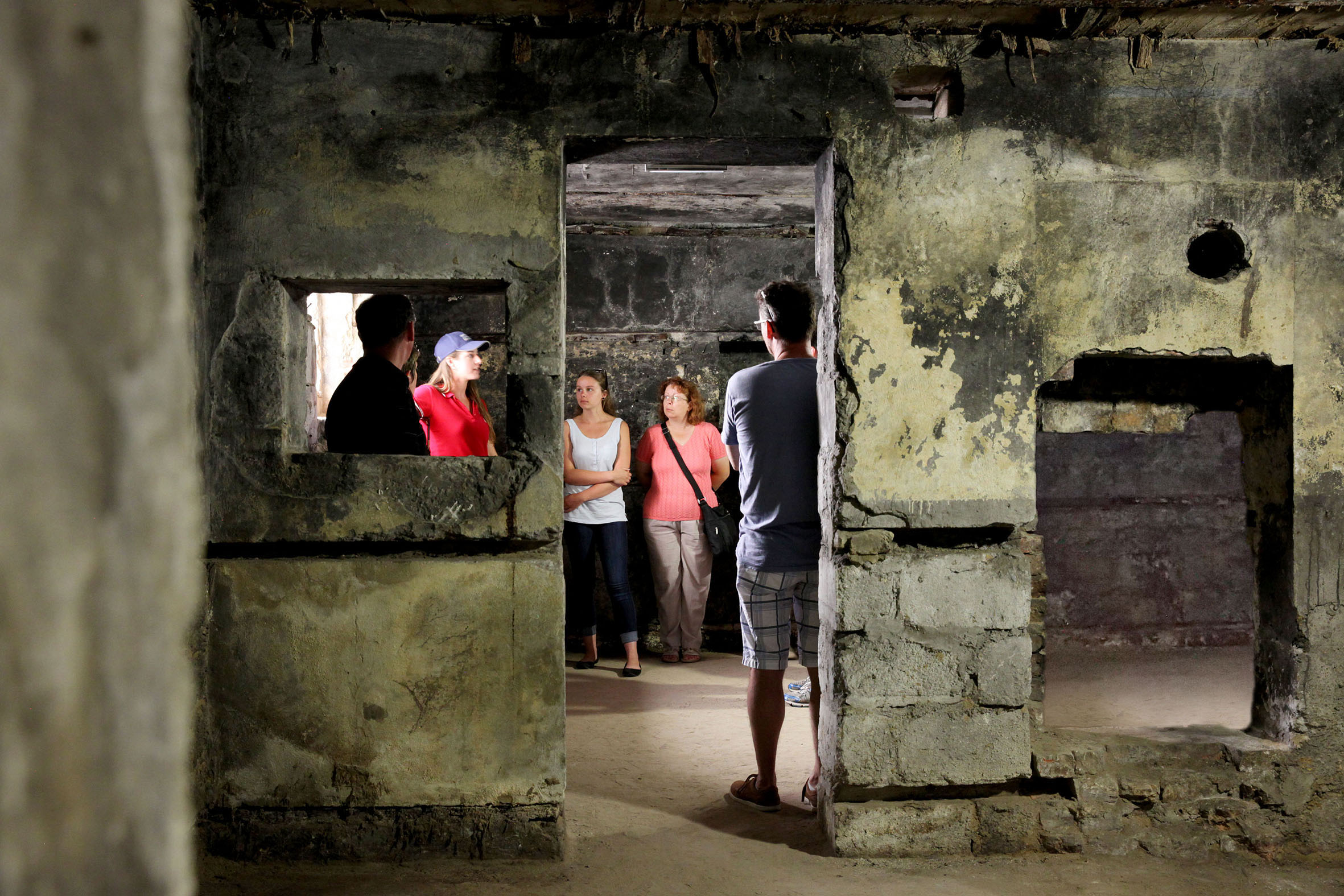
The Centre’s Canadian Guides take visitors on 45-minute tours through this historic site. During the tour, visitors can see firsthand the evolution of the Atlantic Wall defenses throughout the early 1940s. From the early Command Post, built in 1941, to the Observation bunker built just months before the landings in 1944, there is a lot of history to see and explore. The visit then concludes on the beach itself, in order to show how it was that these defences were overcome by the 14,000 Canadian soldiers who landed on Juno Beach on June 6, 1944.
The German Command Post and the Observation bunker are only accessible as part of the guided tour offered by the Juno Beach Centre.
Places are limited. 45min. 6 years old and up. Visits can be canceled due to bad weather.
For groups, tours are available year-round, except in January, by reservation.
Tour in English
Tour in French
For groups, tours are available year-round, except in January where it is by reservation.
Explore Juno
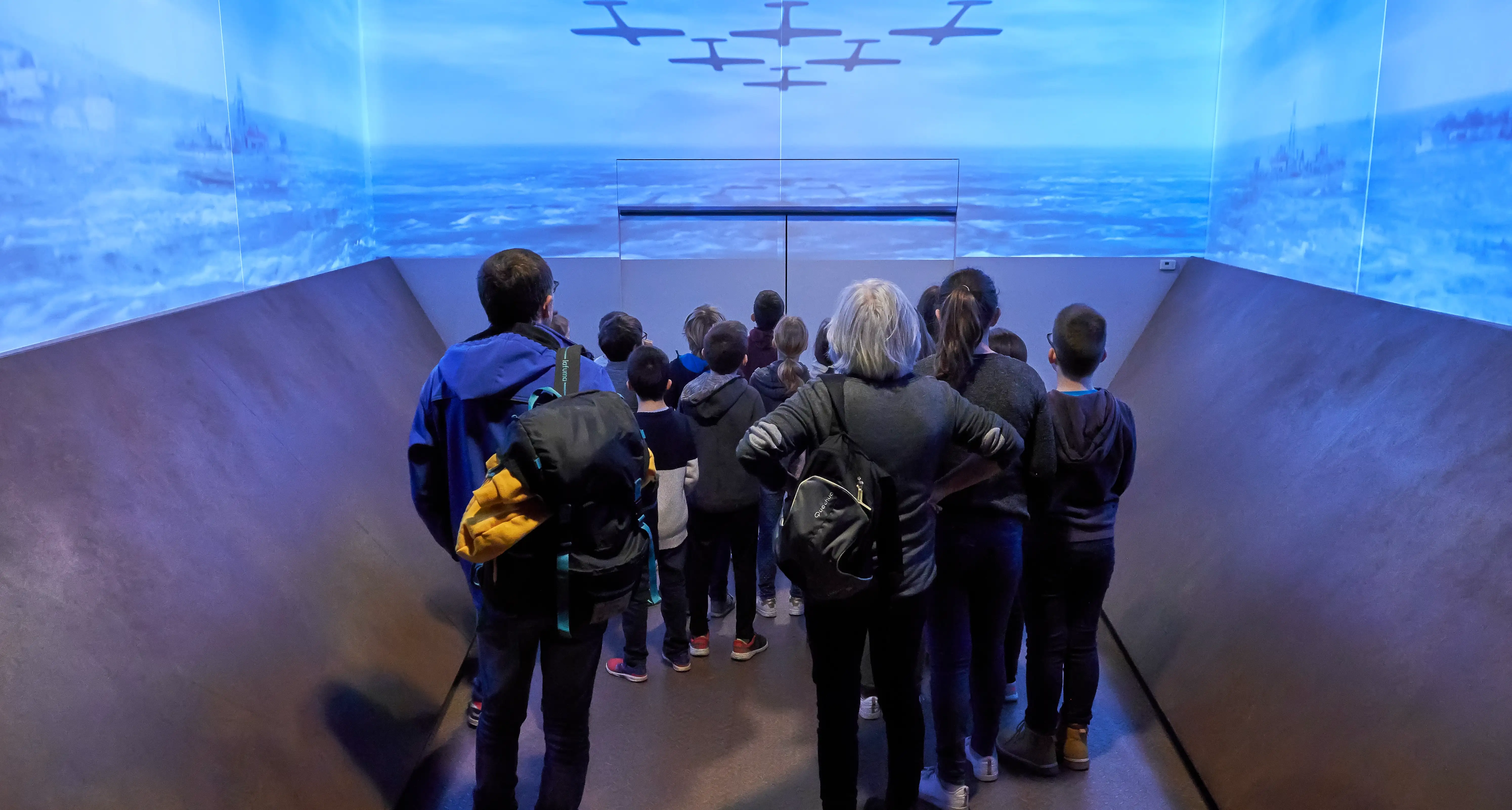
“Explore Juno” is a youth circuit and accompanying educational activities that help children to discover the history of this conflict through different points of view: civil and military. Each module enables children and teens to reflect on historic concepts addressed specifically to them. Interactive games tied to the permanent exhibition allows for a better understanding of the transformation of the country from the 1930s to today, by leaning on such historically universal themes as immigration, total war, democracy and dictatorship, peace, and remembrance. Above all, the contents bring forth the experiences of men and women as well as youth who experienced the Second World War. This experiential visit encourages dialogue and critical thinking among all age-levels. In the last room, families tally up their points and learn more about Canada today, its culture, geography, climate and people. The tour ends with an exchange about the importance of memory work with one of the Canadian guides of the Juno Beach Centre.
Explore Juno for families is included with admission, no reservation required. Explore Juno for school groups is a guided activity with a Canadian guide, by reservation.
Audio Guide
Let Peter guide you through the Centre's permanent exhibition on a narrated audio tour lasting approximately 90 minutes. From room to room, he takes you through the story of Canada's contribution to the Second World War while sharing the anecdotes and behind-the-scenes stories that make the museum unique.
Whether you're visiting the Centre for the first time or returning to experience it again, this audio guide will help you delve deeper and make the most of your visit.
Available in French, English, German, Dutch, Spanish and Italian, the audio guide can be added to your admission ticket for just €2 and is accessible directly on your smartphone.

Juno Caching
Juno Caching is a ten-step adventure to discover memory and biodiversity in Juno Park. Free and accessible.
The land on which the Juno Beach Centre operates is a natural dune area known as Juno Park. The beach was an important site during the Second World War, specifically during D-Day on June 6, 1944, and there are still many remnants of the German defence system that made up the Atlantic Wall. The historic site is also home to beautiful dunes as well as typical seaside flora and fauna and the Juno Beach Centre is committed to preserving the biodiversity that surrounds it.
Through the Juno Caching game, the Juno Beach Centre hopes to introduce a greater number of people aware of the biodiversity surrounding this historical area to better protect it. To participate, simply download and print the game to bring to Juno Park!
This activity is not recommended for school groups.
Practical Information
Vigipirate - Security measures
For security reasons, we do not authorize entry into the museum with luggage or backpacks. See our full Visitor Regulations/Vistor Policy here.

Services at the Museum
At the Juno Beach Centre, visitors benefit from all the services of a modern and innovative museum to ensure an enjoyable visit:
- Free parking on site
- Electric charging station
- Air conditioned rooms
- Wheelchair accessibility
- A souvenir shop
- A variety of restaurants nearby
- Bike shelter equipment
- Electric charging station
- Dogs permitted under certain conditions: Small dogs and dogs of light weight are welcome inside the museum, provided they are carried in your arms or in a suitable bag or stroller. Dogs that cannot be carried in your arms are welcome inside the museum every day between 1:00 p.m. and 2:00 p.m., provided they are kept on a leash.
Languages & Translation
The Webb Visit is a no-download, application available for free at the Juno Beach Centre that allows you to discover texts of the permanent exhibition in French, English, Dutch or German as well as all the films in these 4 languages either in audio or with subtitles, synchronized with the image. The panels of the youth circuit Explore Juno are also available in Dutch on this app.
The application settings allow you to increase the size of the text and the spaces between the words, change the level of gray and contrast, put in dyslexic font and activate a read aloud.
The Webb Visit application provides access to additional content in English or French such as biographies of soldiers or the history of objects in our collections.
Visitors can connect by scanning the QR code dedicated to the Webb Visit in the museum or by following this link (accessible only inside the museum).
This project benefit from the European Regional Development Fund (ERDF) as part of the “Aid for the Ecological and Digital Transition of Tourism” in compensation for the impact of the Covid-19 pandemic on the tourism sector.
Accessibility
The Juno Beach Centre is proud to offer an accessible, interactive and dynamic exhibit space designed for all ages. Admission is free for people with disabilities, with a reduced price for their companion. Guide or assistance dogs are allowed in the museum. Full information on our Accessibility Policies can be found at the link below. For any and all questions related to your visit, you can contact our Accessibility Referent at visit@junobeach.org
Location & Getting Here
Centre Juno Beach
14470 Courseulles-sur-Mer, France
647-297-5341
Rest of the world:
(33) (0)2.31.37.32.17
Fax: (33) (0)2.31.37.83.69
49°20'11.52"N / 0°27'42.52"W
Direction From France
VIA PUBLIC TRANSIT
Calculate your complete travel itinerary on Atoutmod
By train:
By train to either Caen or Bayeux station. You can find the train schedule on the website www.voyages-sncf.com or directly with Nomad Train
Present your SNCF transport ticket at the museum ticket office and benefit from our “low carbon” rate. See conditions in the price list for more information.
Once you arrive in Caen or in Bayeux, you will have to find your way to Courseulles-sur-Mer.
By bus:
To calculate your bus fare and access to the different rates, visit NomadCar
- Line 101 from Caen
– Stop at Courseulles-sur-Mer : Chant des oiseaux, 650m walk (8 min) to the Juno Beach Centre
- Ligne 121 from Bayeux
– Stop at Courseulles-sur-Mer : Chant des oiseaux, 650m walk (8 min) to the Juno Beach
Present your bus ticket at the museum ticket office and benefit from our “low carbon” rate. See conditions in the price list for more information.
Discover the Normandy Discovery Pass 20€ : Unlimited travel for 2 people over 2 days on all intra-Normandy routes by train or Nomad coach.
VIA BIKE
The Juno Beach Centre is located in Courseulles-sur-Mer, on the Juno Park. This territory is near or crossed by several major routes:
The Maple Leaf Route Cycling Tour. Departing from the Juno Beach Centre, the Tour continues through the Normandy hinterland and then heads north to the port of Dieppe. It also features additional tours – namely the American and British landing beaches, as well as the First World War Memorial at Vimy Ridge. The Maple Leaf Route Tourist Guide, on sale at the JBC store and online, is a 130-page book in colour that contains important information. There you will find maps with different routes, historical overviews, and detailed information about each tour and route.
The Vélo Maritime is a bike route from Roscoff in Brittany, to Dunkirk, on the Belgian border. This route goes through Courseulles-sur-Mer, near the Juno Beach Centre. This route crosses legendary sites such as the Pink Granite Coast, Mont-Saint-Michel and its bay, the Landing Beaches, the cliffs of Etretat, the Bay of Somme and the Opal Coast. It is an ideal cycling route for cyclists looking for an escapade, a challenge, and a cultural and gastronomic discovery.
The D-Day Landing Beaches route to Mont Saint Michel is located west of the Juno Beach Centre. This bicycle route guides cycle tourists in the footsteps of History and the Battle of Normandy. This section follows small roads allowing you to admire by bike the richness of the Bessin buildings and the landscapes of the Norman Bocage.
The Vélo Francette is a continuation of the Vélo Maritime near the town of Courseulles-sur-Mer. This 600km bike from Ouistreham to La Rochelle crosses Normandy, the Pays de la Loire and Poitou-Charentes.
There are many other bike routes in Normandy to discover Région Normandie, Calvados Attractivité, Coeur de Nacre Tourism or Bayeux Tourisme.
VIA CAR
The Juno Beach Centre is located at the heart of the landing beaches, in the seaside town of Courseulles-sur-Mer. Our parking is accessible for cars, camper vans and buses. Parking is only open during the museum’s operational hours.
2 electric recharging stations are available in the car park, including one for people with reduced mobility.
Address : VOIE DES Français LIBRES 14470 COURSEULLES-SUR-MER
Google maps
Mapquest
Mappy
ViaMichelin
Waze
Or enter the GPS coordinates of the Centre in your navigation system: 49°20’11.52″N / 0°27’42.52″W
VIA TAXI
The taxi stop is directly opposite the train station. A one-way trip to Courseulles costs between 40€ to 65€ depending on the company and the time of day. Ask the driver for an estimate if you want to avoid unpleasant surprises. Ask the driver to drop you off at the Juno Beach Centre in Courseulles.
Direction From England
VIA EUROSTAR
It is possible to take a Eurostar train (www.eurostar.com) from St Pancras International or from Waterloo Station in London to Gare du Nord in Paris. Travel time is a bit less than 2 1/2 hours between London and Paris. You then need to change train stations to take a regional train from Paris Saint Lazare to Caen.
A car journey via the Euro Tunnel to Calais is also possible. Travel time between Calais and Courseulles-sur-Mer is approximately 3 1/2 hours, depending on traffic.
VIA FERRY
- from Portsmouth to Cherbourg (about 5 hours crossing)
- from Portsmouth to Caen-Ouistreham (about 7 hours crossing)
- from Portsmouth to Le Havre (about 6 hours crossing )
- from Dover to Calais which is the shortest crossing, however you will need to drive, take the bus or take the train from Calais to Courseulles-sur-Mer
Note: to get to Portsmouth from London, you have several options: train, bus (National Express) or car rental. Trains from Heathrow and Central London are quite accessible.
LD Lines: Every mile with a smile. To reach Normandy by ferry from Great Britain.
Brittany Ferries
VIA PLANE
- from London to Paris
- from London to Le Havre
- from London to Deauville-St-Gatie
- from London to Cherbourg-Maupertuis
Note: no direct flights to Courseulles-sur-Mer or Caen are available.
Calculate the carbon impact of your trip
Additional Experiences & Ways to Visit
FREQUENTLY ASKED QUESTIONS
Booking
How do I book a tour?
Since guided tours of the site are offered on a first-come-first-served basis, we always recommend booking your tickets online and well ahead of time.
1. To do so, navigate to the top right-hand corner of our webpage and click on the red “Book Tour” button.
2. Navigate to the right-hand corner and click “Access to my space.”
3. Once on that page click on the grey “Sign up here” button on the centre of the screen below the login information.
4. Once you have entered your information, please click the blue “Create your account” button at the bottom of the page. Do not forget to fill out the mandatory fields marked with the red asterisk
5. Once your information has been successfully entered into our system, you will receive an email from Billetterie@madparis.fr.
6. Go to your inbox and click the “Activate my account” link. Once clicked, you will be redirected to our ticket webpage.
7. On your screen it should now say “Your account is activated.” Under that text, click on “Continue purchases.” You will be redirected to our tour options page.
8. Next, select a tour option and click on the blue “Reserve” button. Select a date and time on the calendar, then select your desired number of tickets and ticket type.
9. Lastly, click the blue “Add to cart” button followed by the blue “Pay” button, and wait for your tickets to be emailed to you.
10. On the day of your visit, please arrive at least desk 15 minutes before the start of your visit, to scan your tickets. Please note that reduced rates and free admission are available to those who qualify (click here to see if you qualify). Proof of entitlement will be required on the day of your visit. Tickets purchased online are non-refundable.
What is included in the tour?
There are several ways to visit the Juno Beach Centre. The self-guided tour of the Juno Beach Centre, including the permanent and the temporary exhibition can be done at your own pace, we recommend about an hour and a half to fully view the permanent exhibit and about 45 minutes to view the temporary exhibit. The guided tour of Juno Park and the remains of the Atlantic Wall, which is led by one of our young Canadian guides includes a visit inside two bunkers opposite the museum. You can combine these visits for a discounted price.
Guided tours are available for visitors aged six and over, and last around 45 minutes. A large part of the guided tour takes place outdoors and may be cancelled due to weather conditions.
* If you have site-related questions or concerns, please contact Catherine Quintal at visit@junobeach.org.
What times are in-person tours offered? Are virtual tours offered?
The Juno Beach Centre tours are offered nearly everyday–with the exception of special events–from April, May, June, September, and October at 11:30 AM and 3:30 PM in French and 10:30 AM and 2:30 PM in English. In July and August, tours are offered at 11:00 AM, 12:00 PM, 3:00 PM, 4:00 PM, and 5:00 PM in French and at 10:30 AM, 11:30 AM, 1:30 PM, 2:30 PM, 4:30 PM in English.
*In some cases, virtual tours may be offered to select groups and individuals. To learn more about group reservations please contact Rebecca Le Savoureux at resa@junobeach.org.
How do I visit the site? Do I need a private tour guide?
Visitors do not require a private tour guide to visit the Juno Beach Centre’s museum and to get a tour of the beach and bunker defences, as it is our own Canadian guides that give these tours. The Juno Beach Centre offers tours in English and French at specific times of the day. Please note that space is limited due capacity limits and the tours being offered on a first-come-first-served basis. We recommend booking in advance to avoid disappointment on site. Ultimately, visitors are welcome to explore the Juno Beach Centre and the area around the Centre (including the beach) independently, though a tour operator is always helpful if you wish to visit the other landing sites, memorials, and cemeteries.
Travel
How do I get to the Juno Beach Centre?
From Paris:
Many of our visitors fly into Paris directly from their home country. Alternatively, if you are flying out of London, United Kingdom, you can land at airports in Paris, Le Havre, Deauville-St-Gatien, or Cherbourg-Maupertus in France. Please note that there are NO direct flights to Courseulles-sur-Mer or Caen. Our recommendation is to fly into Paris directly and travel to the Juno Beach Centre from there as that is the optimal starting point.
Travelling around France can be daunting for those unfamiliar with the transport system. Fortunately, there are several options available depending on your time and budget. Usually, the most affordable and efficient way to travel the country is by train, bus, or private vehicle. In the event you are in France and the Centre is open, please call us if you require assistance. If you are outside the country and require assistance, please take time zones into consideration.
By train:
To get to the Juno Beach Centre from Paris you can take the train to either Caen or Bayeux station. Remember that if you are landing at one of the airports in Paris (Paris Charles de Gaulle Airport or Paris-Orly Airport–most popular options), you will have to leave that airport via shuttle, train, or private vehicle to travel to a Paris train station–Saint-Lazare station or Paris Montparnasse station–that can take you directly to Caen or Bayeux. Please note that the Paris airports listed above are usually a thirty-minute plus commute from the city area no matter the transport method.
Once at one of the Paris train stations, you can buy tickets to Caen or Bayeux at SNCF booths or self-service machines–do not be afraid to ask SNCF employees for help. See the train schedules on the SNCF website. We also recommend downloading the SNCF mobile application. Booking directly through the SNCF is always suggested to avoid third party charges. Moreover, given the unresolved labour action in the country it is advisable to have the mobile application with notifications turned on in the event of train cancellations and or delays.
*Tip: Once you arrive at the Juno Beach Centre you can present your SNCF transport ticket at the museum ticket desk and benefit from the Centre’s “low carbon” rate. See conditions in the price list for more information.
Once you arrive in Caen or Bayeux, you will have to find your own way to Courseulles-sur-Mer. You can take a taxi, bus, private vehicle, or use a tour operator. If you wish to take a taxi, you can typically find them outside the train stations. A one-way trip to Courseulles-sur-Mer may cost anywhere between 40€ to 65€–depending on the company and the time of day. If no taxis are readily available near the stations we suggest Googling taxi companies near you and giving one a call. Alternatively, you can also try to order a ride via a ride company such as Uber, Lyft, or Bolt.
*Tip: If you find a taxi driver, make sure to ask for a cost estimate if you want to avoid unpleasant surprises. Ask the driver to drop you off at the Juno Beach Centre in Courseulles-sur-Mer.
By bus:
If you wish to travel to the Juno Beach Centre by bus you can book a FlixBus or BlaBlaBus from Paris Charles de Gaulle to Caen
From Caen, you can calculate your bus fare and view the offered rates by visiting Nomad Car 14.
Option 1: Line 101 from Caen–
– Stop at Courseulles-sur-Mer: Chant des oiseaux, 650m walk (8 min) to the Juno Beach Centre.
Option 2: Line 121 from Bayeux–
– Stop at Courseulles-sur-Mer: Chant des oiseaux, 650m walk (8 min) to the Juno Beach Centre.
Option 2: D-Day Line
– Between Grandcamp-Maisy and Courseulles-sur-Mer, the D-DAY Line enables visitors to travel along Omaha, Gold and Juno Beaches, allowing you to explore the many sites linked to the D-Day Landings and ensuing Battle of Normandy. This shuttle bus service is easy to use and operates daily from 13 May to 30 September 2024, and at regular times between 9:30am and 6pm.
Tip: Present your bus ticket at the museum ticket desk and benefit from the Centre’s “low carbon” rate. See conditions in the price list for more information.
By private vehicle:
The Juno Beach Centre is located at the heart of the D-Day landing beaches in the seaside town of Courseulles-sur-Mer. If you are travelling by car we suggest inserting the following address into your GPS of choice: Centre Juno Beach, Voie des Français Libres, BP 104, 14470 Courseulles-sur-Mer, France. You can also manually enter the GPS coordinates of the Centre into your navigation system: 49°20’11.52”N / 0°27’42.52”W.
*Our parking lot is accessible for cars, camper vans, and buses. Parking is only open during the museum’s operational hours. For those with electric vehicles there are two recharging stations available in the car park–including one for people with reduced mobility.
We recommend using one of the following GPS applications:
Apple maps
Google maps
Mapquest
Mappy
ViaMichelin
Waze
By tour operator:
Some of our visitors choose to travel around France through international and local tour operators. This is a great option for those that may wish to avoid some of the complexities of commuting to the Centre. Depending on the company, you may be picked up by the operator in Paris or you may be required to travel to Caen, Bayeux, Courseulles-sur-Mer, or another nearby town to begin your tour. For a list of affiliated tour operators please visit this link.
From London:
Many of our visitors travel from the Isles. That said, it is possible to take a Eurostar train from St. Pancras International or from Waterloo Station in London to Gare du Nord in Paris and then make your way to Saint-Lazare or Paris Montparnasse station destined for Caen or Bayeux. Please note that travel time is typically under 2.5 hours between London and Paris. You then need to change train stations to take a regional train from Paris, which takes a similar amount of time to arrive at Caen or Bayeux.
By private vehicle:
A car journey via the Eurotunnel to Calais is also possible. Travel time between Calais and Courseulles-sur-Mer is approximately 3.5 hours, depending on traffic.
By ferry:
Some visitors may travel by ferry (LD Lines/ Brittany Ferries). This can be done by taking a ferry from Portsmouth to Cherbourg (approx. 5 hours crossing), from Portsmouth to Caen-Ouistreham (approx. 7 hours crossing), from Portsmouth to Le Havre (approx. 6 hours crossing), or from Dover to Calais which is the shortest crossing. However, you will still need to drive, bus, or take the train from Calais to Courseulles-sur-Mer.
* Please note that to get to Portsmouth from London there are several options: train, bus (National Express), or car rental. Trains from Heathrow and Central London are also quite accessible.
Accomodation
Where can I stay in Normandy?
While we are not partnered or affiliated with any hotels of any sort in Caen, Bayeux, Courseulles-sur-Mer, and Normandy generally, you can contact the tourism office, Coeur de Nancre, for recommendations and more information. Alternatively, you can conduct an independent search for accommodation on Google or using applications such as Airbnb. Booking your accommodations ahead of time is always advisable, especially prior to special events, ceremonies, and high-traffic periods as vacancies are usually limited and fill up rapidly.
Other Questions
Which tour operator should I hire?
Many of our visitors elect to travel around France via international and local tour operators. This is a great option for those who may wish to avoid some of the complexities of commuting to the Centre and navigating the Normandy region. Due to the dozens of tour companies operating out of France, one can usually receive historical interpretation in the language of their choice and delivered by professional historians and tour guides. For a list of affiliated tour operators please visit this link book a tour with a company that visits the Juno Beach Centre.
How do I research my ancestor(s) that participated in the Second World War?
Although the Juno Beach Centre offers a plethora of resources on the Second World War–which are freely available to the public on our website–we ALWAYS recommend getting in contact with Library and Archives Canada. These institutions have an extensive collection of artifacts and materials. As such, they are in the best position to aid you in terms of resources and experts to answer any questions you may have about the Second World War or your ancestor(s). You may also contact Hélène Cavillon, who may be able assist you throughout your research process.
*For any Juno Beach related historical question(s), please contact alex@junobeach.org.
I still have unanswered questions. Who should I contact?
A. If you still have questions, please send us an email–contact@junobeach.org. We typically respond to inquiries within a matter of days.
Donate
to the JBC
As a primarily privately-funded museum, it’s our donors who have made the dream of the Juno Beach Centre a reality.
Learn more about the unique initiatives you can help fund or make a gift to our general fund today to honour the legacy of Canada’s Veterans and ensure their story continues to be told.







