
Veteran Stories
Two Brothers Fighting in Opposite Theatres of War
In honour of National Indigenous Peoples Day in Canada, the Juno Beach Centre is sharing the stories of two Indigenous Second World War Veterans of the Métis Nation who will be featured in the upcoming renewal of the Faces of Canada Today permanent exhibition.
The Juno Beach Centre is pleased to partner with First Peoples Group, an Indigenous advisory organization in Canada, on all material relating to Indigenous Peoples in the Faces of Canada Today exhibition. Working as an Indigenous Partner, First Peoples Group ensures a representation of Indigenous peoples’ participation and resilience in the Second World War that is culturally and historically accurate and appropriate, in addition to current Indigenous realities in contemporary Canada.
Enlisting in the Canadian Army was no easy task for John and Jimmy Moar. In 1941, the two brothers had to walk about 160km from their home town of Crane River, Manitoba in order to reach a recruitment office and enlist. This journey took about seven days, with the young men sleeping outdoors and stopping at farms to offer their labour in exchange for food. The Moars successfully enlisted and eventually travelled overseas, separating to serve in opposite theatres of combat before ultimately surviving the war and returning home.
Private James “Jimmy” Moar
After Jimmy enlisted, he trained for two months before shipping off to Hong Kong in September 1941 with the Winnipeg Grenadiers.
Shortly after Jimmy’s arrival, the forces of the Empire of Japan began to bomb Hong Kong. On December 19, he was wounded by a piece of shrapnel. Then on Christmas Day, only six days after Jimmy’s injury, Hong Kong surrendered to the Japanese forces. Jimmy and all the other Allied Forces on the island became prisoners of war.
During his nearly four-year imprisonment, Jimmy and his comrades were set to work removing a mountain to make space for an airstrip. The main equipment they had to remove the dirt and rock were wicker baskets.
As a result of this physical labour and the very slim food rations he was given, Jimmy dropped from 160lbs to 80lbs.

Commander Peter MacRitchie of H.M.C.S. Prince Robert meeting with liberated Canadian prisoners-of-war at Shamshuipo Camp. Photo: Petty Officer Jack Hawes / Canada. Dept. of National Defence / Library and Archives Canada / PA-193015
After the war ended, Jimmy began the long journey back to Canada. He was initially sent to Honolulu where he stayed for 3 months to rebuild his strength. He then went on to Vancouver before finally returning to his hometown in Manitoba.
The years of imprisonment, labour, and near starvation had changed Jimmy’s appearance so severely that his mother only recognized him by the sound of his voice.
Jimmy reintegrated himself in his community, becoming a volunteer firefighter, and later, Fire Chief. He sat on the local school board, served as Mayor, and held memberships with the Royal Canadian Legion, Hong Kong’s Veteran Association, and Aboriginal Veteran’s Association. As a member of the Métis Nation, Jimmy did not receive the same compensation as non-Indigenous Veterans.
Rifleman John Moar
Like his brother Jimmy, John enlisted with the Royal Winnipeg Rifles in 1941. But, instead of being sent to Hong Kong like his brother, John served for two years in England: ultimately training to participate in the Allied invasion of Normandy in 1944.
On D-Day, June 6, 1944, the Royal Winnipeg Rifles landed on Juno Beach in Normandy, France. As John jumped into the water and began to wade towards the shore, he could hear bullets whizzing by his head. Moving as fast as he could, John had to wade pas the bodies of his comrades, praying to his mother for protection.
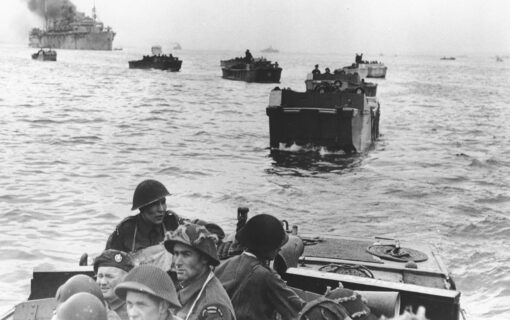
On board their assault landing crafts, men of the Royal Winnipeg Rifles heading towards their sector of Juno Beach, June 6th, 1944. Photo by Dennis Sullivan. Department of National Defence / National Archives of Canada, PA-132651.
In spite of the heavy fighting on D-Day and the many days and months of fighting through France, Belgium and the Netherlands that followed, John survived the war without injury.
When the war ended, he travelled back to a town called Dauphin, Manitoba. From there, he walked roughly 160km to his home town; the same distance he had travelled years earlier in order to enlist in the war effort.
Sitting by the window one day, John’s mother saw a man approach the house and thought “You know, that man walks like our John.” She had not been notified that John was on his way home and was overjoyed to realize that the man was in fact, her son. Like his brother, Jimmy, John did not receive the same compensation as most Veterans because he was a member of the Métis Nation.
See more

Donate
to the JBC
As a primarily privately-funded museum, it’s our donors who have made the dream of the Juno Beach Centre a reality.
Learn more about the unique initiatives you can help fund or make a gift to our general fund today to honour the legacy of Canada’s Veterans and ensure their story continues to be told.







