Veteran Stories
Witnesses to History: Victor Thorhallur Magnus
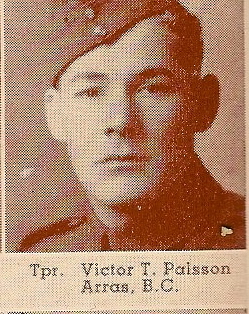
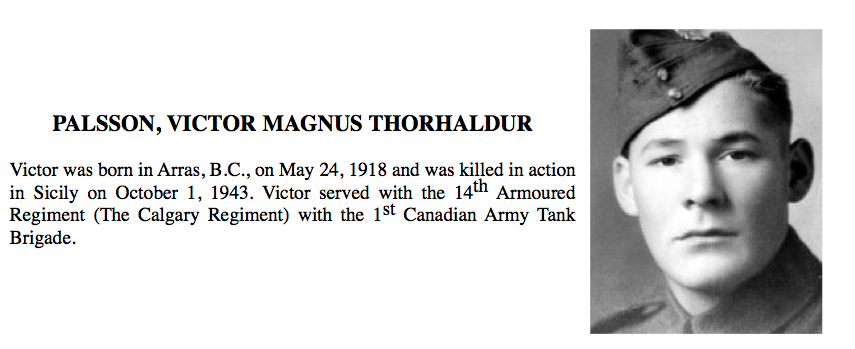
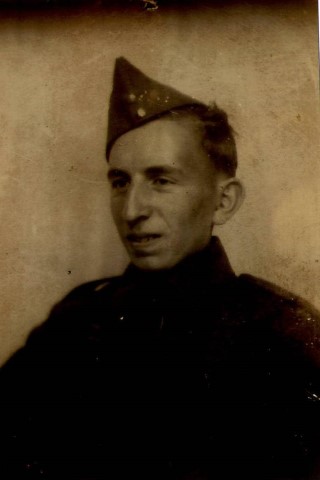
Victor Thorhallur Magnus Palsson was born in 1918 as a second generation Icelandic immigrant and decided to enlist in the military in 1940.
He trained in Canada for just over a year and in the U.K. for another year. He was a part of the 14th Army Tank Regiment, also known as the Calgary Tanks. He would get his tank license on June 12th 1942 before his Unit departed Canada for the U.K. on June 20th 1942.
On August 18th 1942, his regiment was the first unit of the Canadian Armoured Corps ever to go into action. They were a part of Operation Jubilee, the Dieppe Raid. He survived and made it back to the U.K. on August 19th 1942.
He spent the next year training in the U.K., including receiving his mechanic qualifications on November 4th 1942, before boarding a ship to Sicily on July 13th 1943 and survived Operation Husky. He then moved to Italy. As the order to move forward from the position the Canadians held on September 29th was given the Calgary Tanks would move forward from Foggia early the morning of October 1st 1943. As they made their way into the Motta Ridge, they were held down by German fire in the exposed valley. Six Tanks from the Calgary Regiment were gunned down by German 88s, Victor’s was most likely one of them. He was 25 years old.
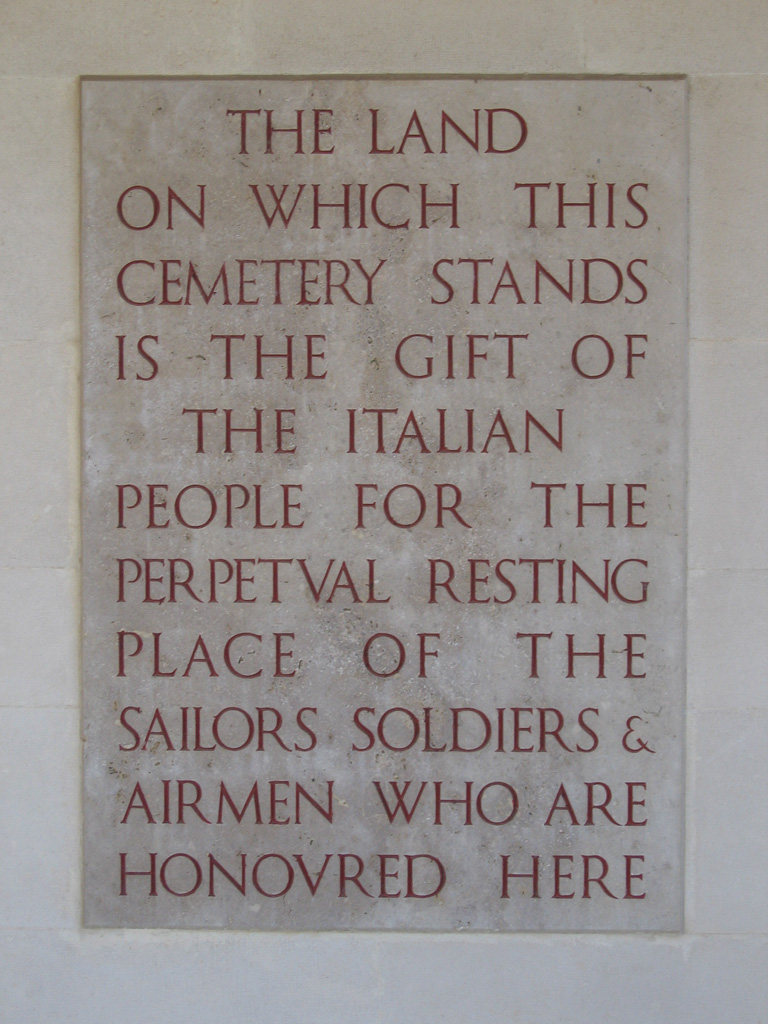
On 3 September 1943 the Allied invasion of the Italian mainland began with landing in the south near Reggio and, a few days later, in the Gulf of Salerno. The invasion coincided with an armistice made with the Italians who then re-entered the war on the Allied side. Allied objectives were to draw German troops from the Russian front and more particularly from France, where an offensive was planned for the following year.
The site of Bari War Cemetery was chosen in November 1943. There was no serious fighting in the vicinity of the town, which was the Army Group headquarters during the early stages of the Italian campaign, but it continued to be an important supply base and hospital centre, with the 98th General Hospital stationed there from October 1943 until the end of the war. At various times, six other general hospitals were stationed at Trani and Barletta, about 48 km away.
Besides garrison and hospital burials, the cemetery contains graves brought in from a wide area of south-eastern Italy, from the ‘heel’ right up to the ‘spur’. Here too are buried men who died in two disastrous explosions in the harbour at Bari, when ammunition ships exploded in December 1943 (during a German air raid) and April 1945.
Bari War Cemetery contains 2,128 Commonwealth burials of the Second World War, 170 of them unidentified. There are also some non war burials and war graves of other nationalities.
The cemetery also contains 85 First World War burials, brought in from Brindisi Communal Cemetery in 1981. Most of these burials are of officers and men of the Adriatic drifter fleet which had close associations with Brindisi during the First World War.


See more


Donate
to the JBC
As a primarily privately-funded museum, it’s our donors who have made the dream of the Juno Beach Centre a reality.
Learn more about the unique initiatives you can help fund or make a gift to our general fund today to honour the legacy of Canada’s Veterans and ensure their story continues to be told.