
Veteran Stories
Witnesses to History: Gérard Bruyère
Corporal Gérard Bruyère, originally from the Saint-Édouard district of Montreal, enlisted in 1940 as a volunteer and took part in the Dieppe Raid and the Normandy campaign.
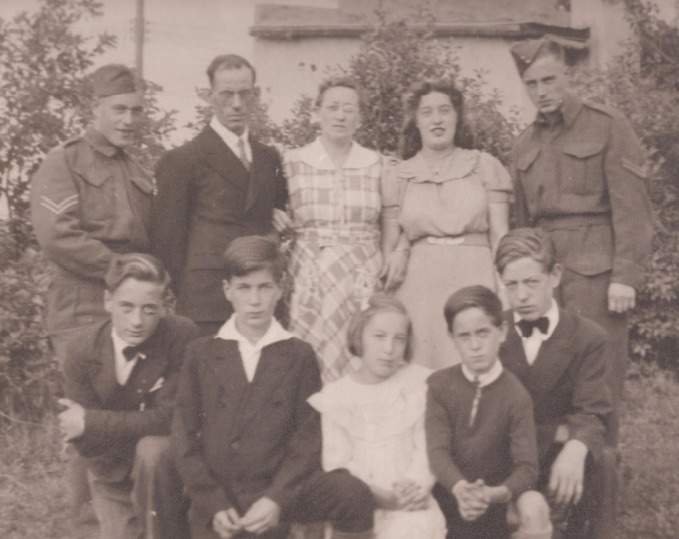
Gérard Bruyère and his family, 1943. Top row, from left to right: Gérard, Arthur (father), Cécile (mother), Jacqueline Rozon (Bruyère) and Roger. Bottom row: Jean-Guy, Yvon, Denise, André and Jacques. (Source: André Bruyère).
Gérard Bruyère was born on March 21, 1922 in the Saint-Édouard district of Montreal (today, Rosemont-La Petite Patrie borough). Son of Arthur Bruyère and Cécile Vincent, he was the third in a family of eight children. Young Gérard left school around the age of 15 and found a job as a messenger for the Montreal Blue Print company, with the aim of helping his parents financially.
The Commitment of a Family
In 1939, even before the outbreak of war, his older brother Roger enlisted in Le Régiment de Maisonneuve. Gérard, in turn, enlisted in July 1940 in Le Régiment de Châteauguay. Shortly after, he was transferred to Les Fusiliers Mont-Royal. Three of his brothers, Jacques, Jean-Guy and Yvon, eventually enlisted when they were old enough to do so. Only André, the youngest son of the Bruyère family, did not serve because he was too young.
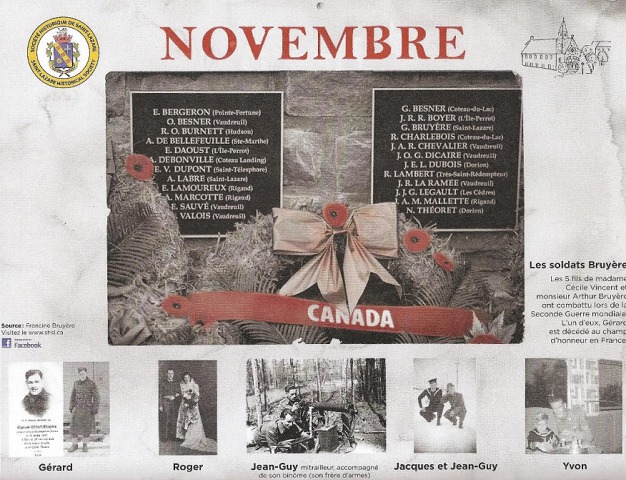
Photo of the cenotaph plaques at Hudson and the Bruyère brothers who served in the war. (Source: Historical Society of Saint-Lazare, Francine Bruyère)
Gérard and Roger had the opportunity to be together during their training at Valcartier. It is said in the family that when Roger announced to Gérard that he was leaving for England the next day, Gérard immediately went to ask his officer to leave at the same time as his brother. The officer granted Gérard’s request. He sailed from Halifax on October 5, 1941, arriving in Liverpool on October 17. He was first integrated into various training units in Surrey, south-west of London, before returning to Les Fusiliers Mont-Royal in April 1942. From then on his training intensified. He and his comrades were training for their first engagement on European soil: the Dieppe Raid.
A Visit to Dieppe
On August 19, 1942, the Fusiliers Mont-Royal Regiment took part in the Dieppe Raid, code named Operation Jubilee. Little is known about Gérard Bruyère’s personal experience during the raid. Bruyère, who escaped the Dieppe Raid with other soldiers*, left no story or report. We know, however, that he exercised the role of signalman. In addition to participating in the assault with his brothers in arms, the signalman carried a radio transmitter and remained in communication with an escort boat, which stood offshore. He had to provide, in real time, the progress of the troops and the state of the situation ashore.
*Under cover of a thick smoke screen and the protection of the R.F.A. the soldiers in a position to do so, even wounded, embarked on barges and then went back and boarded the boats, for the return to England.
After the events of August 19, 1942, Gérard Bruyère continued to serve in England. Daily life followed its course, punctuated by its exercises and downtime. According to Lieutenant Jean-Napoléon Maurice, a veteran of Les Fusiliers Mont-Royal who knew Gerard and whom his brother André went to meet at his home in 2000, Gérard Bruyère was considered by his comrades to be a skilled writer. His status as a fine writer meant that several soldiers asked Gérard to write their letters to their mothers and girlfriends.

Newspaper article published in La Presse (Montreal, September 10, 1942, p.31). Gérard Bruyère can be seen in frame 5, third from the left. This photo was probably taken shortly after his return to England. Note: in box 6, in the center, we can see Lieutenant Jean-Napoléon Maurice. (Source: Press Collection, Cécile Bruyère)
Toward Normandy
In June 1943, Gérard was promoted to the rank of corporal. A year later, on July 6, 1944, he sailed again for France. He was among the additional troops sent to Normandy after the D-Day landings on June 6. In the context of Operation Goodwood, he took part in Operation Atlantic, which consisted of an assault on the Verrières ridge near the town of Beauvoir and the hamlet of Troteval, about 8 kilometers south-west of the city of Caen, between July 18th and 20th.
The attack by “C” Company Les Fusiliers Mont-Royal against the Troteval farm began on July 20. Their objective was to seize this farm. The Troteval Farm, like many other farms, towns and hamlets in the region, was occupied and defended by the Germans, who had a large arsenal to defend this area. The Fusiliers Mont-Royal fought valiantly around the farm buildings, surrounded by a stone wall, and all around in the wheat fields. But the arrival of tanks from the SS Panzer Division will stabilize and delay their action and their objective. The men of the Fusiliers Mont-Royal still able to fight, of Companies “D”, “B” (which had just seized the Beauvoir farm with the help of the expected reinforcements) and those of Company “C”, with the assistance of tanks from the Sherbrooke Fusiliers and the support of artillery*, took the Troteval farm definitively on 25 July.
*Delayed by the German resistance, the numbers of which were poorly assessed and underestimated before the start of Operation Goodwod, the economic situation and the state of the roads and heavy rains on their route.
Gérard Bruyère died on July 26, 1944. Corporal Bruyère is today commemorated at the Bayeux Memorial (plate 22), in the Calvados department in Normandy.
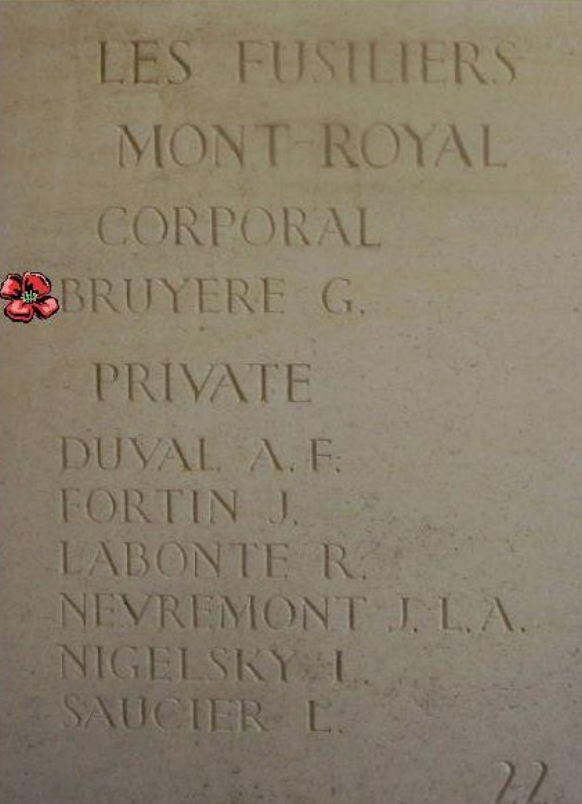
Plate 22 from the Bayeux Memorial, Normandy. You can see the name of Gérard Bruyère there. (Source: André Bruyere)
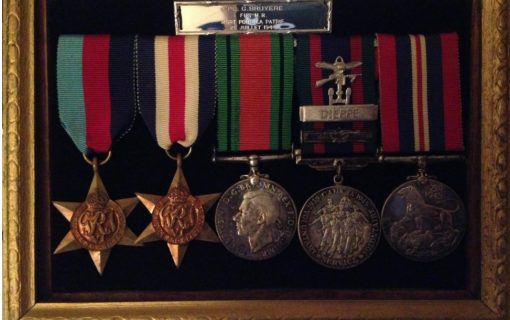
Frame containing Gérard Bruyère’s 5 medals. From left to right: The 1939-1945 Star, the France and Germany Star, the War Medal 1939-1945, the Canadian Volunteer Service Medal and the reverse of the 1939-1945 War Medal. (Source: Gérard Bruyère, son of Jean-Guy Bruyère)
Gérard Bruyère received the 1939-1945 Star, the France and Germany Star, the Defence Medal, the Canadian Volunteer Service Medal with clasp, the War Medal 1939-1945, the Memorial Cross and the Dieppe clasp.

The two faces of Gérard Bruyère’s Memorial Cross (Source: Gérard Bruyère, son of Jean-Guy Bruyère).

Gérard Bruyère’s Dieppe clasp. (Source: Gérard Bruyère, son of Jean-Guy Bruyère)
In 1997, the local president of an association of Dieppe veterans sought out its members to pay them a tribute of recognition from the French government. Gérard being deceased, I presented myself as the only living member of the family. Gerard was on the list. I received this tribute and gave it to my nephew Gérard Bruyère, son of Jean-Guy (Bruyère) and Gabrielle, born November 11, 1954, Armistice Day, so named in memory of my brother. This tribute was added to my brother’s military medals, of which my nephew is the custodian.
André Bruyère, brother of Gérard Bruyère
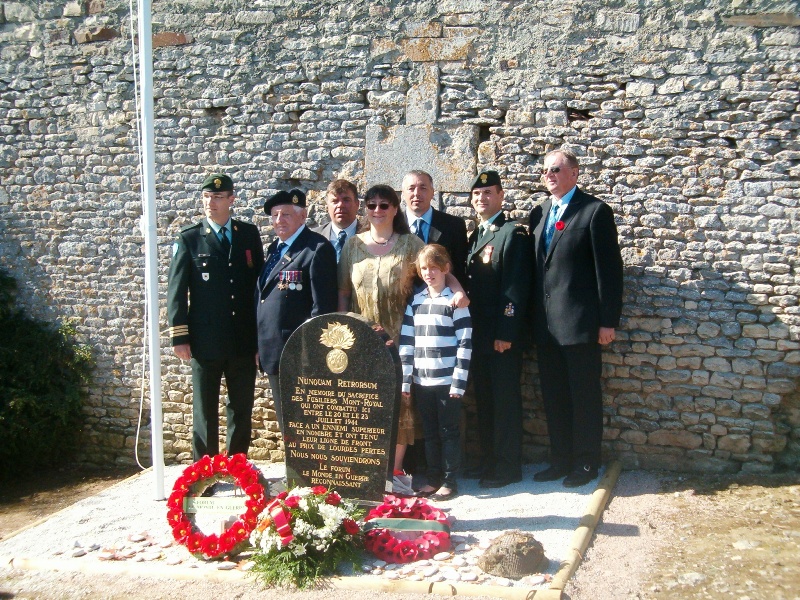
Inauguration of the monument in homage to the Fusiliers Mont-Royal, in the presence of Mr. Guy Frimout, owner of the Ferme Troteval (on the right) (Source: http://www.drivehq.com/file/df.aspx/publish/vvjack/wwwhome/rha/normandie2009/index.htm )
The Fusiliers Mont-Royal’s motto is NUNQUAM RETROSUM which means NEVER RETREAT. All of these soldiers have endorsed and applied this principle by serving at the risk of their lives. And this is why, from now on, our motto must be NEVER FORGET.
In your memory forever, brother of my mother Jacqueline.
See more
Donate
to the JBC
As a primarily privately-funded museum, it’s our donors who have made the dream of the Juno Beach Centre a reality.
Learn more about the unique initiatives you can help fund or make a gift to our general fund today to honour the legacy of Canada’s Veterans and ensure their story continues to be told.