
Importance of Working Together
Since 2019, the Juno Beach Centre (CJB) has been committed to a sustainable development approach, which takes the form of a Corporate Social Responsibility (CSR) plan built around 4 pillars and taking into account an annual greenhouse gas assessment (BEGES):
- Sobriety (Reduce the environmental footprint and encourage the emergence of a circular economy).
- Rallying (Commit to visitors and staff).
- Preservation (Act for biodiversity).
- Mutual support (Act with others).
The actions carried out under this 360° strategy relate mainly to the museum’s infrastructure and operations, its offer, its commitment to visitors and staff, biodiversity, public awareness, and collaboration with other players in memorial tourism.
THE QUESTION OF ATTENDANCE AND VALUE
With some hindsight, measurable and measured BEGES results and a regular CSR report, the CJB is regularly invited to speak and share lessons learned at meetings, round tables, training sessions and so on, run by institutions and by private or public bodies, partners from the worlds of tourism, culture and business.
“In our professional world, there is one question our peers almost always ask us: can you quantify the increase in your attendance, and therefore your revenue, resulting from your sustainable actions?
But is that really the best way to judge the quality, relevance and value of our actions and results? The answer is probably yes, but not only. By widening the focus, we can identify other benefits, particularly in the results of the memorial tourism sector.” Nathalie Worthington, Director of the CJB
Indeed, consuming less water or electricity and managing waste better does not directly bring in more visitors. Obtaining the Tourism and Disability label by promoting inclusion brings more visitors without increasing revenue (free admissions). Co-building quality of life at work for staff does not either; it is often first of all a financial cost. Supporting carbon sinks in forests with the ONF (France’s National Forests Office) is also not likely to increase attendance and earn money.
So why do it if it doesn’t increase the number of visitors and represents a cost? Because the wealth generated by sustainable actions is not counted solely and directly in attendance and therefore in euros.
THE CASE OF THE LOW-CARBON RATE AND THE POWER OF THE COLLECTIVE
In 2020, Maxime Bouché, deputy director of the CJB, carried out the CJB’s first greenhouse gas assessment (BEGES). It highlighted that more than 80% of greenhouse gas (GHG) emissions came from visitor transport alone.
“Armed with this finding, I came up with the Low-Carbon Rate (TBC), which was put in place in 2021, with the aim of encouraging visitors to favour soft mobility (train, bus and bike) by giving them a preferential rate. As part of this, I initiated a pioneering partnership with the SNCF (French national railway).
This rate quickly inspired other players/regions such as Lyon and La Cité des Sciences in Paris (sustainable mobility rate), which introduced a similar rate.” Maxime Bouché
After two years of operation and observation at the CJB, Normandie Tourisme took over and expanded the scheme, which now covers more than 120 Normandy sites. This change of scale gives it a much greater impact on tourist mobility practices: one site offering a low-carbon rate is a signal, but more than 120 committed sites make it possible to embed this approach in a genuine regional dynamic.
From its launch, the CJB made the institutional choice to accept a drop in revenue linked to the reduced rate, in order to encourage the use of soft mobility. This approach aims to help reduce greenhouse gas emissions and, in doing so, to try to act on the causes of climate change rather than on its consequences alone.
At the scale of a single establishment, such an initiative might seem modest. Yet it is part of a collective effort to change visitors’ travel habits. When an entire region takes up the scheme and rolls it out on a large scale, the whole territory contributes to decarbonizing tourist mobility.
This example clearly shows that the value of an action, minimal on a small scale, becomes a force when it is carried by an entire territory.
From 2021 to December 2025, the CJB recorded a total of 7,502 low-carbon rates, mostly from visitors arriving by bike (70%), train (20%) and bus (10%).
At the level of the Normandy Region, since 2024, 17,000 low-carbon rates have been recorded, with an average split of 60% bike, 30% train and 10% bus.
ANOTHER WAY OF ESTIMATING VALUE
The CJB is a partner of the Liberation Route Europe (LRE), a European network dedicated to remembrance that has also taken up the environmental issue. It is within this framework that the museum took part in the PPSF project (Preserving the Past, Securing the Future) and was able to share its experience with other European sites.
Following the exchanges held under the PPSF project, Paolo Eugenio Corti (professor and sustainable tourism expert at the Fondazione Campus Studi del Mediterraneo) proposed to the Juno Beach Centre a model for analyzing the value created (economic, social, cultural, tourism-related and environmental). One of the elements of analysis in this model is the pyramid of evidence:
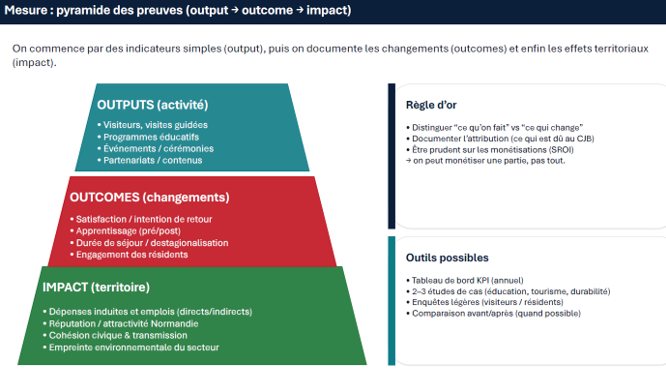
This tool is read from top to bottom. By applying this work to the example of the Low-Carbon Rate, it is possible to analyze and document the contribution of this action to territorial impact.
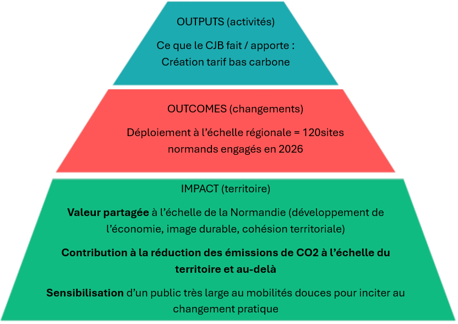
Interpretation: At the top, the OUTPUT, the creation of the Low-Carbon Rate by the CJB. Below it, the OUTCOME, the change brought about by the creation of the OUTPUT. At the very bottom, the IMPACT on the territory, analyzing the shared value.
After the CJB created the Low-Carbon Rate (“contribution of one actor”), the Normandy Region adopted it and developed it at regional level, going on to inspire other regions and European partners. The primary value is the change of scale in impact across the following areas:
Economic: Attractiveness for the CJB, the intercommunal Tourist Office and the local economic ecosystem (restaurants, shops, transport providers). Complementarity with local policies on developing cycle paths. The Low-Carbon Rate is in line with the actions led by the Département and the Region, which fund the construction of cycle paths across the territory. It is also an economic boost for the construction sector.
Environmental: Encouragement to reduce car use (75% of visitors to the D-Day beaches came by car in 2022 [1]) and a broader contribution to decarbonizing travel, with the resulting positive effects for the climate (example: a round trip from Paris to Courseulles by train emits about 4.91 kg CO₂eq versus about 73 kg CO₂eq by combustion-engine car [2]).
Social: Making travel easier for tourists and residents. Making the remembrance and tourism subject accessible by public transport, and therefore to more people. Raising awareness of soft mobility among tourists and locals.
Image: Positioning the CJB and Normandy as an actor/territory committed to the fight against climate disruption (aligned with SDGs 11 and 13 and the SNBC).
“The value of a sustainable action is measured by its ability to produce an observable change and to spread that change beyond the actor that initiated it. When a local initiative is taken up, amplified and built into a regional dynamic, its value becomes economic, social, cultural and environmental. The challenge is then to make this value visible and to document each actor’s contribution to the collective impact.” Paolo Eugenio CORTI
THE WEALTH CREATED BY COOPERATION BETWEEN ACTORS AND TERRITORIES
SHARING EXPERIENCE AT REGIONAL LEVEL
Last June, Normandie Tourisme published an article summarizing its participation in the European Forum on Sustainable Tourism Mobility (9 June 2026, Breda University, Netherlands). At this event, Normandie Tourisme shared its experience in sustainable tourist mobility, highlighting in particular:
- the necessary cooperation between tourism and mobility actors;
- the partnership initiatives under way in the Normandy region, which led in particular to the creation of the summer line 125;
- the experiment carried out with Granville Terre et Mer; the low-carbon rate scheme aimed at encouraging visitors to choose more sustainable forms of mobility.
The knock-on effect among partners
The Low-Carbon Rate partnership between the CJB and the Normandy Region led to the observation of a gap in the Cœur de Nacre area, the intercommunality in which the CJB is located: bus services are suited to school transport only. A dialogue was therefore opened with Cœur de Nacre Tourisme (CNT).
“With the director of CNT, I carried out a study of public transport distribution, which made it possible to revive a project that was abandoned in 2022, a bus line along the D-Day beaches.” Maxime Bouché
In 2024, a line linking various memorial sites on the D-Day beaches, the DDAY line, was thus able to come into being. However, because the line’s launch was communicated too late, the service was not always coordinated with train arrivals at the Caen and Bayeux stations, and some runs were cancelled, this initiative did not enjoy the hoped-for success.
For summer 2026, drawing on this experience, the Normandy Region and Normandie Tourisme decided to adapt the line by turning it into summer line 125. With the option of carrying bikes on board to encourage soft mobility as much as possible, the link between two stations, Caen and Bayeux, and three bus lines (120, 121 and 101), this line promotes intermodality across the territory.
Alongside the development of bus line 125, the work of this same group of actors led to the development of a “Door-to-door between Paris and Courseulles-sur-Mer” offer for the summer 2026 season.
“Line 125 and the ‘Door-to-door Paris–Courseulles-sur-Mer’ offer perfectly illustrate how a collaborative approach between the CJB, the Cœur de Nacre Tourist Office and the Normandy Region can address issues that are both local and global. These projects, born of a shared will, now benefit the whole territory, from visitors to residents.” Nathalie Papouin, Director of Cœur de Nacre Tourisme (CNT)
As this article is being written, we have learned that the Museum of the Second World War in Gdańsk is introducing a special rate for its visitors who cycle, inspired by the CJB under the Preserving the Past, Securing the Future programme.
THE KNOCK-ON EFFECT FOR THE BENEFIT OF THE ACTOR
By extending the soft mobility examples above to other CJB actions, six blocks of the value chain proposed by Paolo Corti’s model emerge:

The first column lists the 6 dimensions/blocks of the value chain. In the middle are some examples of actions at the CJB, and on the right, the value created by those actions.
CONCLUSION:
The benefits of the CJB’s sustainable development approach go well beyond its own field of action. They make it an actor that offers proposals and lessons learned in the service of the general interest. Isn’t the main wealth a shared vision and the demonstration that local innovation can contribute to impact at different territorial scales (local, regional and global)? What is certain is that institutions and local authorities have every interest in relying on, supporting and promoting committed local actors. As for the actors, without this relay of support, the reach of their actions would remain limited. Experiences of collaborative work between actors of the territory are an important variable in the fight against climate disruption and in favour of more sustainable development of the territory. In the end, everyone can be proud of the work accomplished together.
“The examples developed in this article show different levels of maturity and measurement. Some schemes, such as the Low-Carbon Rate, already have data that document their implementation, use and spread. For other effects, notably some economic, social or territorial spin-offs, the impacts identified are at this stage probable contributions whose scale will need to be documented by additional indicators.” Paolo Eugenio CORTI
Acknowledgements:
- The Normandy Region, which has supported the CJB’s sustainable development approach since 2020.
- Normandie Tourisme, which took over regional topics (Low-Carbon Rate, bus lines, pooling of resources).
- The Cœur de Nacre Tourist Office, a partner of the museum, for its strong commitment to more responsible tourism.
- Liberation Route Europe (LRE), which develops and relays committed projects such as the PPSF at European level, and offers essential opportunities to meet.
- Paolo Eugenio Corti, professor and sustainable tourism expert at the Fondazione Campus Studi del Mediterraneo, whose work on value sharing inspires the CJB to measure, and in future try to maximize, its territorial impact.
- MJConseil, with Mathieu Janhich and Aurélie Wastin, independent consultants in responsible communication who support the CJB’s approach, including in writing its articles.
Donate
to the JBC
As a primarily privately-funded museum, it’s our donors who have made the dream of the Juno Beach Centre a reality.
Learn more about the unique initiatives you can help fund or make a gift to our general fund today to honour the legacy of Canada’s Veterans and ensure their story continues to be told.







