
Podcasts
Crerar’s Lieutenants with Geoffrey Hayes
Subscribe: Apple Podcasts | RSS | Spotify | Stitcher
Commanding an infantry platoon in 1944 was arguably the most dangerous job in the world. General Harry Crerar, Canada’s top army commander during the war, kept tabs on his officer fatalities to ensure they were taking their share of the casualties. As it turns out, his officers took more than their share. Even though the infantry arm of the Canadian Army represented only 17 percent of its strength, 70 percent of lieutenants who died outside of Canada during the war served with the infantry. Many of these officers didn’t survive long enough for their men to learn their names.
Regardless of how long they lasted in the line, lieutenants were subject to intense and immense pressures. Expectations from both enlisted men below and superior officers above heightened the burden. During the Second World War, the Canadian Army attempted to define an ideal junior officer to guide their policies on officer selection, training, and management. Junior officers then had to navigate through their wartime experiences in the context of these ideals. Practical wartime demands and notions of social class and masculinity all had an impact.
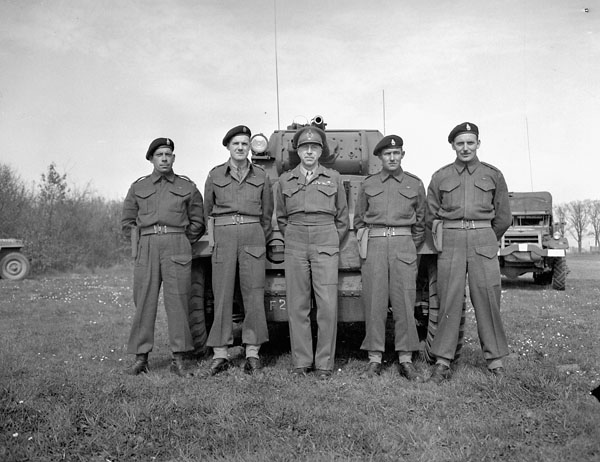
General H.D.G. Crerar, General Officer Commanding-in-Chief First Canadian Army, with personnel of The Royal Montreal Regiment, in front of a Daimler armoured car, Grave, Netherlands, 11 April 1945 (Capt. Ken Bell / DND / LAC / PA-164024).
Time Stamps
5:45 Crerar and His Lieutenants
7:45 The Ideal Canadian Army Officer Evolves
16:15 Centralizing Officer Training
26:56 The Moral Equipment to Inspire
31:10 Into Combat with the Junior Officer
37:43 Support from Above and Below
42:20 Pressures Facing the Junior Officer
47:10 How Junior Officers Were Perceived by their Men
49:30 Towards A Better Understanding of First Canadian Army’s Culture
Guest Biography
Geoffrey Hayes is the author of Crerar’s Lieutenants: Inventing the Canadian Junior Army Officer, 1939-1945. Geoff is an associate professor in the Department of History at the University of Waterloo. He is on the Board of Directors of the Canadian Battlefields Foundation and often spends part of his summer leading battlefield study tours to Northwest Europe.
Notes
The following links offer more information on the topics discussed in this episode:
Arms & Weapons
Events
People
Credits
Juno Beach and Beyond is hosted and edited by Alex Fitzgerald-Black, the centre’s Digital Projects Coordinator.
Mackenzie King’s speech to British Parliament from the British Pathé YouTube channel: https://www.youtube.com/watch?v=6SlEvclY5LE&t=48s
Artillery firing sounds from the CBC News: The National YouTube Channel: https://www.youtube.com/watch?v=RsCSQ4uWR1Y
Female veteran’s voice (Eileen Green, née Short) Courtesy of The Memory Project, Historica Canada: http://www.thememoryproject.com/stories/383:eileen-green-nee-short/
Winston Churchill’s “Finest Hour” speech from Jonathan Thomas’s YouTube channel: https://www.youtube.com/watch?v=jB5wZtV1MWM
Spitfire sound effect from Jason Kirby’s YouTube channel: https://www.youtube.com/watch?v=xgZI4tAoMN0
Dramatic Interlude by Alexander Nakarada | https://www.serpentsoundstudios.com
Music promoted by https://www.free-stock-music.com
Attribution 4.0 International (CC BY 4.0)
See more
Donate
to the JBC
As a primarily privately-funded museum, it’s our donors who have made the dream of the Juno Beach Centre a reality.
Learn more about the unique initiatives you can help fund or make a gift to our general fund today to honour the legacy of Canada’s Veterans and ensure their story continues to be told.







