
Podcasts
Casualty Identification with Sarah Lockyer
Subscribe: Apple Podcasts | RSS | Spotify | Stitcher
Approximately 27,000 Canadian soldiers and airmen killed during the First World War, the Second World War, or the Korean War have no known graves. Some 8,000 went missing during the Second World War.
A couple of times each year, the Canadian Armed Forces will announce that the Casualty Identification Program has identified the remains of a Canadian soldier or airman. This program, established in 2007, has identified (as of November 1st, 2021) 17 Canadian servicemen from the First World War and 17 from the Second World War. In addition, two Second World War servicemen were identified before the formal establishment of the program.
Today’s guest, Sarah Lockyer, joins us to detail the critical work of the Canadian Armed Forces’s Casualty Identification Program. She explains the program’s origins and policies, the process through which casualty identification occurs, the use and limits of science in support of these investigations, and how the remains of previously missing servicemen are finally put to rest.
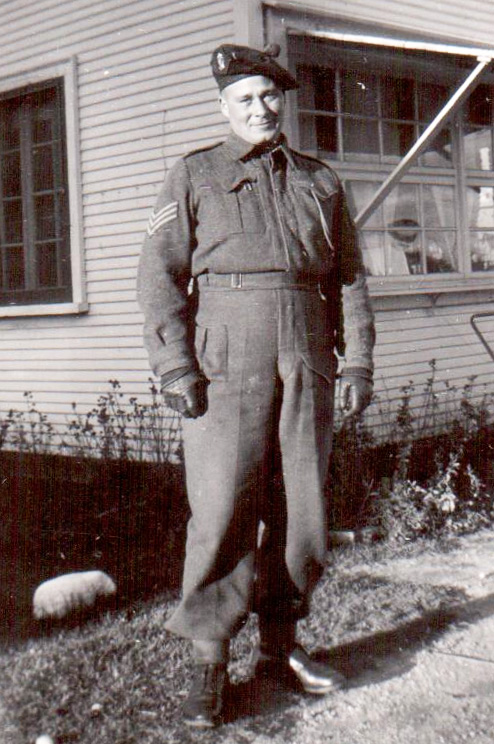
Sergeant John A Collis in battle dress as a member of the Irish Regiment of Canada, before he transferred to the Royal Hamilton Light Infantry (Family of Sergeant Collis, the Canadian Armed Forces’s Casualty Identification Program).
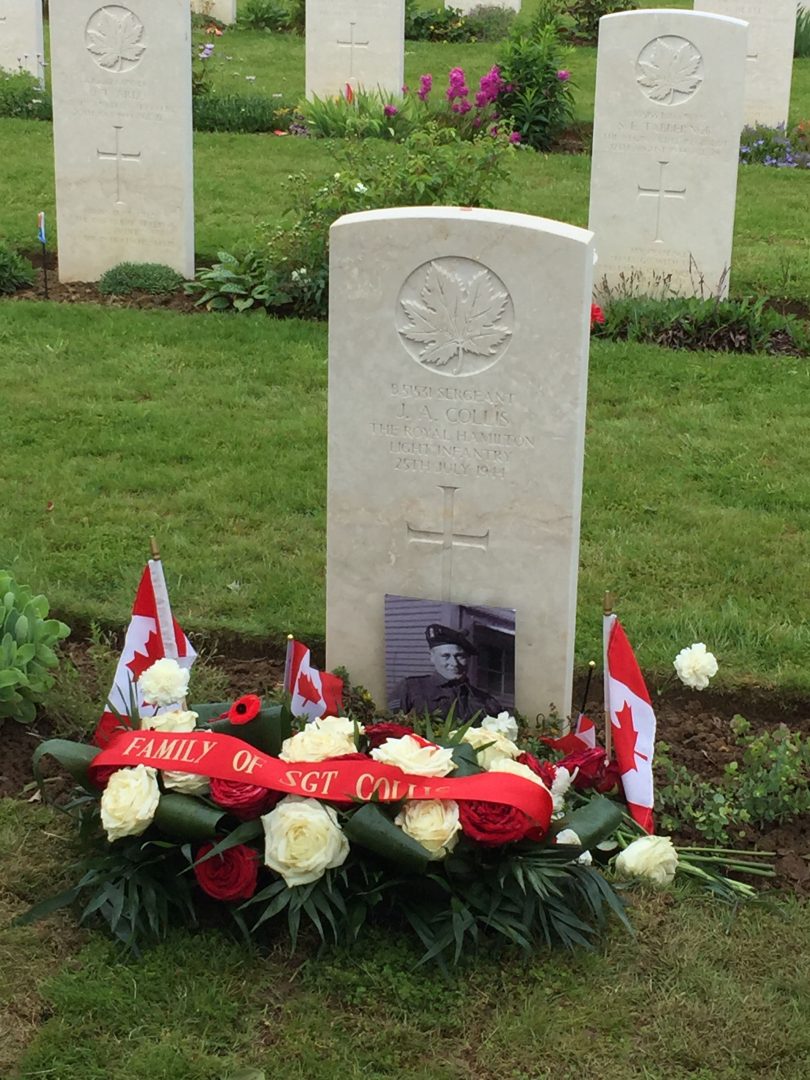
Sergeant John A. Collis’s grave marker at the Bretteville-sur-Laize Canadian War Cemetery in Normandy, June 2019 (Canadian Virtual War Memorial).
Patreon
Help keep us on the air! Become a patron for Juno Beach and Beyond for as little as $2 per month. Make your secure contribution through Patreon.com.
All proceeds support the Juno Beach Centre, Canada’s Second World War Museum in Normandy, France and allow us to continue to offer this content to listeners across Canada!
Time Stamps
2:20 Program Origins
5:34 Policy Legacies
8:45 Discovery of Remains
11:03 Narrowing with History
14:30 Biological Profile
18:35 Forensic Dentistry
21:09 DNA Analysis
28:31 Sergeant Collis
39:24 Casualty Identification Review Board
41:56 Putting Remains to Rest
Guest Biography
Dr. Sarah Lockyer is a forensic anthropologist who works for the Canadian Armed Forces as their Casualty Identification Coordinator. An Acadian from New Brunswick, she earned her PhD in bioarchaeology at Bournemouth University in the UK.
Notes
The following links offer more information on the topics discussed in this episode:
Podcasts
The Power of Place with Graham Broad
Missing Airmen with Sean Summerfield
Remembrance Day 1944 with Matthew Halton
A Question of Honour with David O’Keefe
7 Days in Normandy with Scott Entwistle
Voices of Juno with Desaree Rosskopf
Events
Credits
Juno Beach & Beyond is hosted and edited by Alex Fitzgerald-Black, the centre’s Executive Director.
Mackenzie King’s speech to British Parliament from the British Pathé YouTube channel: https://www.youtube.com/watch?v=6SlEvclY5LE&t=48s
Artillery firing sounds from the CBC News: The National YouTube Channel: https://www.youtube.com/watch?v=RsCSQ4uWR1Y
Female veteran’s voice (Eileen Green, née Short) Courtesy of The Memory Project, Historica Canada: http://www.thememoryproject.com/stories/383:eileen-green-nee-short/
Winston Churchill’s “Finest Hour” speech from Jonathan Thomas’s YouTube channel: https://www.youtube.com/watch?v=jB5wZtV1MWM
Spitfire sound effect from Jason Kirby’s YouTube channel: https://www.youtube.com/watch?v=xgZI4tAoMN0
Dramatic Interlude by Alexander Nakarada | https://www.serpentsoundstudios.com
Music promoted by https://www.free-stock-music.com
Attribution 4.0 International (CC BY 4.0)
See more
Donate
to the JBC
As a primarily privately-funded museum, it’s our donors who have made the dream of the Juno Beach Centre a reality.
Learn more about the unique initiatives you can help fund or make a gift to our general fund today to honour the legacy of Canada’s Veterans and ensure their story continues to be told.







