

This article is part of a four-part series on the 1st Canadian Parachute Battalion in the last seven weeks of the war. Click below to read the accompanying sections.
- PART 1: Varsity to Wismar
- PART 3: A Quick Advance
- PART 4: Reaching Wismar
Operation Varsity was the most successful Allied airborne operation of the war. The hard lessons from Overlord and Market Garden were learned well. The anti-aircraft guns that had been turned on bomber raids heading for the Ruhr were neutralized before they could be redirected at the ground forces making their first major foray into Northern Germany. As with every operation in which they had been involved, 1st Can Para achieved their objectives on time and held them.

1st Canadian Parachute Battalion, London, England, January 1944 Credit: Canadian War Museum, 20020045-1419
1st Can Para had paid a heavy price for this success, however. Sixty-seven out of 475 soldiers were casualties. Their CO, Lt. Col. Jeff Nicklin, was killed at the outset when he came down over a German entrenchment and was riddled with bullets. His body was found still hanging from his parachute that had become entangled in a tree. Fraser Eadie assumed leadership of the battalion and led with courage and resolve to the end of the war. (Since 1946, the Jeff Nicklin Memorial Trophy – donated by the men of 1st Can Para – has been awarded to the best player among the Western teams of the CFL.)
A 1st Can Para medic, Corporal Fred “Toppy” Topham, earned the battalion’s only Victoria Cross on March 24. One of 16 VC’s to be awarded to Canadians during the Second World War, the honour was well deserved.
Citation

Corporal Fred “Toppy” Topham, VC
On 24th March 1945, Corporal Topham, a medical orderly, parachuted with his Battalion on to a strongly defended area east of the Rhine. At about 1100 hours, whilst treating casualties sustained in the drop, a cry for help came from a wounded man in the open. Two medical orderlies from a field ambulance went out to this man in succession but both were killed as they knelt beside the casualty.
Without hesitation and on his own initiative, Corporal Topham went forward through intense fire to replace the orderlies who had been killed before his eyes. As he worked on the wounded man, he was himself shot through the nose. In spite of severe bleeding and intense pain, he never faltered in his task. Having completed immediate first aid, he carried the wounded man steadily and slowly back through continuous fire to the shelter of a wood.
During the next two hours Corporal Topham refused all offers of medical help for his own wound. He worked most devotedly throughout this period to bring in wounded, showing complete disregard for the heavy and accurate enemy fire. It was only when all casualties had been cleared that he consented to his own wound being treated.
His immediate evacuation was ordered, but he interceded so earnestly on his own behalf that he was eventually allowed to return to duty.
On his way back to his company he came across a carrier, which had received a direct hit. Enemy mortar bombs were still dropping around, the carrier itself was burning fiercely and its own mortar ammunition was exploding. An experienced officer on the spot had warned all not to approach the carrier.
Corporal Topham, however, immediately went out alone in spite of the blasting ammunition and enemy fire, and rescued the three occupants of the carrier. He brought these men back across the open and, although one died almost immediately afterwards, he arranged for the evacuation of the other two, who undoubtedly owe their lives to him.
This N.C.O. showed sustained gallantry of the highest order. For six hours, most of the time in great pain, he performed a series of acts of outstanding bravery and his magnificent and selfless courage inspired all those who witnessed it.
(London Gazette, no.37205, 3 August 1945)
The Fighting Trek Across Northern Germany
The Germans were fighting a rearguard action to hold us up. You’d be going down the road and all of a sudden you’d be fired upon. So we’d mount an attack against ‘em and they’d just disappear…It was very very frustrating.
– Major Bob Firlotte, “Victory from Above: the First Canadian Parachute Battalion”
Once the bridgehead was secured, attention was turned to exploiting the gap in the German defences. Eisenhower pulled the U.S. 17th Airborne away from 21st Army Group and sent them southwards with the American 9th Army, so 6th Airborne was attached to British 2nd Army to cross the Elbe river and make for the Baltic.
However, this race for the Baltic was not just military – it had become geopolitical as well. Churchill, warned by diplomatic insiders Averell Harriman and Archie Clark Kerr, foresaw that Stalin would not be held to the Yalta agreements and would seek to impose Communism on all territory taken in eastern Europe. Unfortunately, Roosevelt seemed to still believe that Stalin would stick to the agreement about self-determination of occupied countries. Churchill, who had his faults but certainly knew a threat of tyranny when he saw it, took unilateral action. 6th Airborne – including 1st Can Para – were directed to make with all speed to the Baltic coast city of Wismar. This city had been allocated to the Soviets at Yalta, but its proximity to the Danish border might have been too strong a territorial temptation for Stalin to withstand. Once the Red Army moved in, it was almost impossible to dislodge. Losing Denmark to the Soviets was not a desirable outcome.
In the meantime, they had almost 500 kilometres of enemy-filled territory to cover. They began the advance on 26 March at Issel, then moved the next morning to the village of Burch.
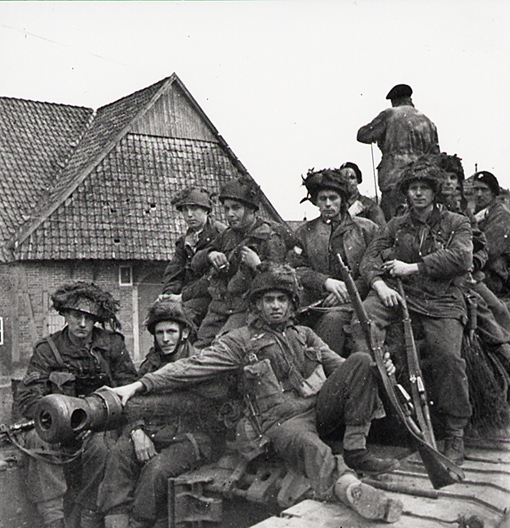
Paratroopers of the 1st Canadian Parachute battalion on a Churchill tank: Privates E. D. Aziz, P. G. Mulroy, Sergeant G. H. Jickels, Privates L. O. Fuson, J. Humeniuk, G. M. Brown, R. H. Carlton. Greven, Germany, April 5th (or 31st March), 1945. Photo by Charles H. Richer. Department of National Defence / National Archives of Canada, PA-142610.
With little resistance encountered there, they moved on to the next objective, a piece of high ground near the village. Ground fog obscured visibility and the men were uneasy. Their discomfiture was justified: a Tiger tank appeared on the roadway. The men fired at the tank from cover and forced it to retreat; but enemy armoured vehicles began firing on them, attempting to stop the Canadians from advancing. Fraser Eadie, now Colonel Eadie, knew the only option to break the obstacle was a frontal assault, but the ground they would have to cover was open and the amount of enemy armour hiding in the woods was unclear. He had no artillery to call on so he would have to make do with the battalion’s own resources: PIAT, mortars, and machine guns.
But then a miracle appeared, in the form of two British jeeps with mounted machine guns. No one knew who they were or where they came from, but they showed up just in time with an offer of assistance which Eadie gratefully accepted. The jeeps flanked the German positions and gave much needed fire support, as well as providing a diversion. The battalion swept through the woods and into the village. The Germans had vanished, as had the British men in the jeeps.
CONTINUE TO PART 3: A Quick Advance