

This article is part of a four-part series on the 1st Canadian Parachute Battalion in the last seven weeks of the war. Click below to read the accompanying sections.
- PART 1: Varsity to Wismar
- PART 2: The Fighting Trek Across Northern Germany
- PART 3: A Quick Advance
1st Can Para and the Royal Scots Greys reached Wismar on May 2, only a few hours ahead of the Red Army, and immediately set up roadblocks on the eastern and northeastern sides of the town. They dug in, not knowing how the meeting with the Red Army was going to go – they hoped for the best but they were prepared for the worst. There were still swarms of German troops heading west – Sgt. Andy Anderson recalled that the pile of weapons taken from the German soldiers as they crossed into Allied-held territory was twenty-five feet long and ten feet high.
At 4 pm, C Company which was covering the bridges of the east side of town, met the first Red Army representative, a Soviet officer of the 3rd Tank Corps of the 2nd Belorussian Front commanded by Marshal Konstantin Rokossovsky. “A Russian officer arrived in a jeep with his driver,” noted the battalion war diary, “it was quite unofficial since he had no idea that we were in Wismar until he came to our barrier. He had come far in advance of his own columns and was quite put out to find us sitting on what was the Russians’ ultimate objective”.
Early the next morning, trouble arose at the Canadian roadblock north of town. Sgt. Andy Anderson was awakened by a phone call, telling him that there were Russians wanting to get past the roadblock.
They want into our lines and are being very belligerent and…they seem to be very drunk. My reaction was that they were the hardest looking bunch of toughs I had ever seen. Their uniforms make no sense; they seem to be peasants armed with German weapons. We start to try and converse with them by sign language because our interpreter has not responded to our phone call. They continue to argue; we offer to take the senior ones to HQ under escort, but they want no part of that. What they will settle for is for Pete and I to get in their truck and go back through their lines, but we do not like that proposition. Finally, in some desperation, they give up and disappear back to the Russian lines, wherever that may be. (“The Boys of the Clouds” by Gary C. Boegel)
The next day, Sgt. Anderson and a small group that accompanied him were sent with an interpreter as a patrol to make a friendlier contact. 1st Can Para was blessed with some members who could speak Russian – one of those examples of how being a nation of immigrants was of great benefit. Once the Soviets understood who the Canadians were, there was “handshaking, hugs, and the vodka bottles started to appear”. Anderson and his group did their level best to keep up with the vodka intake, not wishing to give offense; but they ended up passed out, sick, or both. Anderson barely got them back to their own lines before he was violently ill – which probably saved him from a terrible hangover.
The relationship continued to be unstable. The Soviets insisted on being allowed past Wismar; the Canadians refused to let them through. At one point, an exasperated Col. Fraser Eadie informed an insistent Russian officer, “One of mine can take seven of yours any day of the week, and if you don’t believe me, try it”.
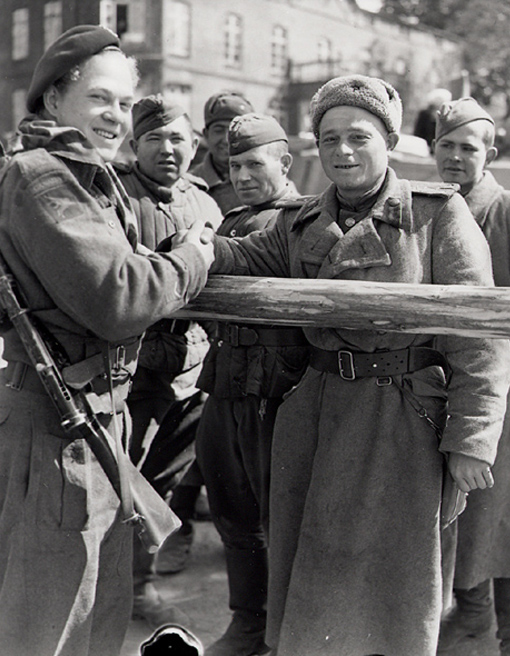
A soldier from the 1st Canadian Parachute Battalion shakes hands with a Russian officer in Wismar, Germany, May 4th, 1945. Photo by Charles H. Richer Department of National Defence / National Archives of Canada, PA-150930.
The Canadians did their best to follow the divisional directive: “Dealings with the Russians will be as far as possible governed by a spirit of Friendliness and tolerance, tempered with firmness.” This was easier said than done. Although the Canadians were not allowed past the armed roadblock the Red Army had set up a few dozen yards east of their own – except for one courier jeep per day – the Russians were to be allowed into the city. Russian access to Wismar created nothing but trouble for the Canadians, who were appalled by the behaviour and poor discipline of the Soviets. Andy Anderson recalled:
Although we had been briefed on what to look for in terms of uniform, rank, discipline and so on, we quickly found out that these were largely peasant rabble, terribly undisciplined and determined to get into the city. They at times appeared to be more our enemy than our ally…
Some of the behaviour was atrocious, even criminal. Private A. Carignan recalled that the Russians “would rape every female between 9 and 90 that they could get their hands on”. Sgt. John Feduck remembers patrolling the city to try to protect the terrified citizens from the Russians’ worst excesses:
…these Russians, they were vicious, they would think nothing of molesting women. I was on night patrol, we heard this screaming…I go upstairs and this Russian guy is shooting at this girl…he had most of her clothes off. She was hiding behind a brick chimney and he’d shoot at her if he saw any part of her. So we got him and knocked him out.
There was also the flood of displaced persons flooding into the Allied lines, which was another headache for the Canadian troops. One dark night a few days after they got to Wismar, Major Bob Firlotte was patrolling, when a woman stopped him in the street near a railway siding. Firlotte remembered this event with great emotion:
She said “I have a trainload of women here, we were evacuated from a hospital in Rostock, and most of them are sick and wounded and hurt, and we have no food, the train has run out of fuel. The engineer and all the train crew have left us, our toilets are all plugged up, we are in desperate condition. Can you help?” And I thought, ‘Oh, god, what the hell can I do?’ Anyway, I got some of my men who could drive a vehicle, and back we went. I went down and walked through the train. One woman was laying there dead … some of them were so far gone we had to carry them out of the train. … We got them all to this gymnasium and got them settled. Thank God there was running water. Talk about human misery, you never saw anything like it. They were scared to death of the Russians.
– “Victory from Above: the First Canadian Parachute Battalion”
Ultimately, the impasse had to be broken by those higher up the chain of command. On May 7, General Rokossovsky met with Field Marshal Montgomery to discuss a resolution. It was a political decision to default to the Yalta accords, and Wismar was to be surrendered to the Russians. The war against Germany ended on May 8, but the friction at Wismar remained for a few days yet, as the Canadians were tasked with keeping order in the town. John Feduck remembers that “When we were told to leave, [the people of Wismar] begged and cried not to leave them with the Russians”, but there was no choice. On May 19, 1st Can Para and the rest of the 6th Battalion troops left Wismar forever, landing back at Bulford the next night. A few weeks later, they were on their way home to Canada.
Brigadier Hill praised the Canadians for their role in “the fighting trek across…Germany when we more than kept pace with the Armoured Division on our flank which ended with our battalion, the Canadians, entering the town of Wismar on the Baltic Sea 3 hours ahead of the Russians, as Sir Winston Churchill had personally demanded”.
Writing and research by Norma Graham.
Suggested reading list:
Lt. Col. Bernd Horn and Michel Wyczynski, Paras Versus the Reich: Canada’s paratroopers at war 1942-45, Toronto: Dundurn Press, 2003.
Lt. Col. Bernd Horn and Michel Wyczynski, Tip of the Spear: an intimate account of 1 Canadian Parachute Battalion 1942-1945, Toronto: Dundurn Press, 2002
Gary Boegel, Boys of the Clouds: an oral history of the 1 st Canadian Parachute Battalion 1942-1945, British Columbia: Trafford Publishing, 2007.
John A. Willes and Mark Lockyer, Out of the Clouds: the history of the 1 st Canadian Parachute Battalion, Kingston: 1 st Canadian Parachute Battalion Association, 1981.
Brian Nolan, Airborne: the heroic story of the 1 st Canadian Parachute Battalion in the Second World War, Toronto: Lester Publishing, 1995.
1 Can Para War Diary, which can be accessed at https://www.project44.ca/