
Newfoundland and Labrador’s Memorial Day

Opening of the Beaumont-Hamel Newfoundland Memorial, France, June 7, 1925. Photo: The Rooms Provincial Archives Division (NA 31-06), St. John's, NL
July 1st marks the celebration of Canada Day across the nation and the anniversary of the country’s official creation on July 1st, 1867. This date is not only significant for the history of the Canadian state however, as it also marks a special occasion of remembrance for the people of Newfoundland and Labrador. Memorial Day has been observed in Newfoundland since 1917 commemorating the sacrifices of its war veterans, and was inspired by the great losses suffered by the Newfoundland Regiment on July 1st, 1916 at Beaumont-Hamel.
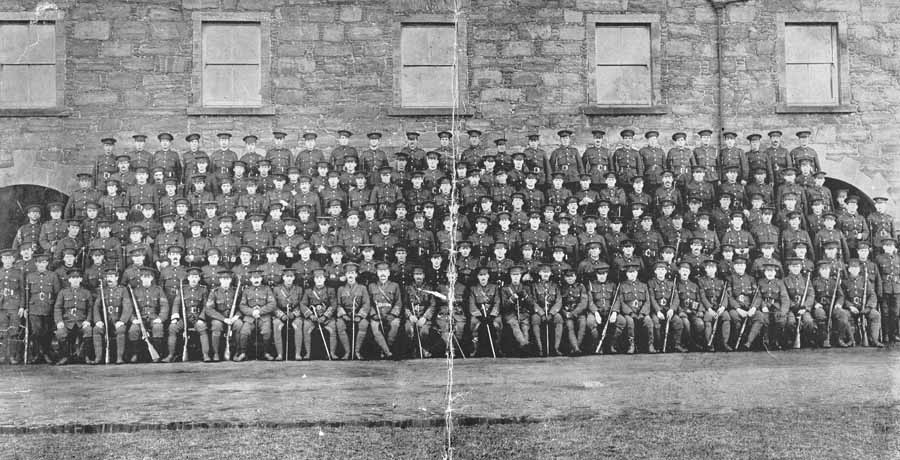
A Company, First Newfoundland Regiment, Fort George, Scotland, 1915 Taken by D. A. Grant, Nairn, Scotland. Formal portrait of officers and enlisted men outside of a stone building at Fort George. Note the Ross rifles. Photographs by D.A. Grant were published in the Newfoundland Quarterly (Oct. 1915) and readers were invited to place orders for various sets of photographs. Price lists and descriptions were provided. Courtesy of The Rooms Provincial Archives Division (C 1-86a), St. John’s, NL.
Considered one of the deadliest battles in history, the Somme Offensive (or the “Battle of the Somme”) began on July 1st, 1916 in an attempt to gain a breakthrough against the heavily entrenched German line near the River Somme in Belgium. The attack had been in planning phases throughout the late winter of 1915 into early 1916, originally designed in coordination with a Russian offensive in the east and an Italian offensive from the South in order to overwhelm the German forces. However, due to an offensive initiated by the Germans in the north-east of France at Verdun, French forces were almost entirely occupied with fighting in this area.
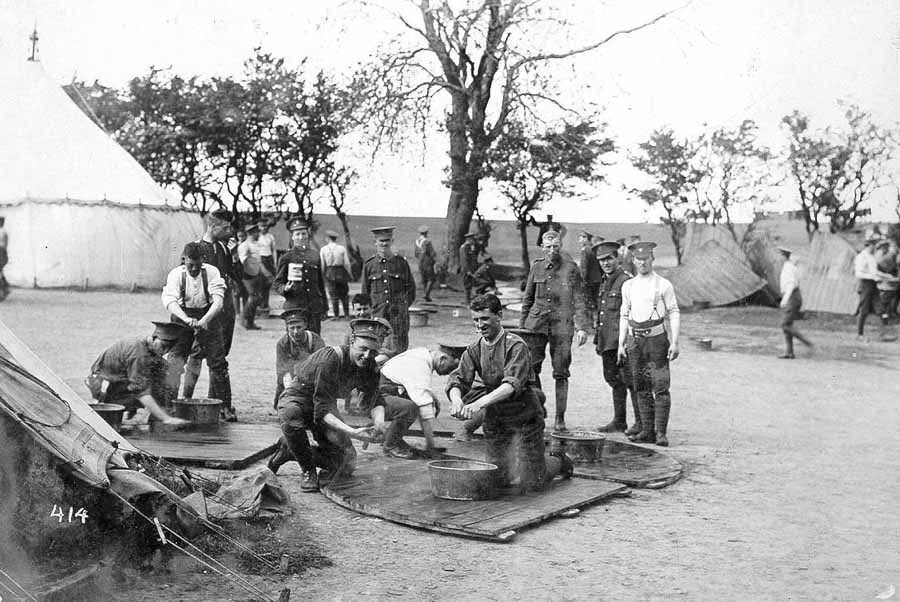
Newfoundland Regiment soldiers, 1915. Men washing at Newfoundland Regiment camp. Soldiers are possibly washing wooden boards, which might be used for temporary shelters. There are other boards in the background. Courtesy of The Rooms Provincial Archives Division (VA 40-21.3), St. John’s, NL.
Subsequently, the planned Somme offensive was advanced to an earlier timeline in hopes that it would provide relief to the French forces at Verdun. While the original objective of the offensive was to provide a decisive victory over the Germans and lead to the end of the war, the primary objective of the battle soon became achieving relief for the French while fighting battles of attrition against the Germans in the West.
At the beginning of 1916, the Newfoundland Regiment had been recovering in Egypt from its participation in the Gallipoli Campaign near the Dardanelles Straight through the late months of 1915 into early 1916. The Regiment had suffered over 44 deaths throughout the campaign, as well as hundreds of hospitalizations due to various injuries and illnesses such as pneumonia- reducing the regiment to just 17 officers and 470 men of other ranks. While reinforcements arrived to the Regiment, it was informed in the spring of 1916 that it would be participating in the Somme offensive as a part of the British 29th Division.
By late March of 1916, the Regiment had departed Egypt and arrived in Europe to begin preparations for the battle. A collection of personal letters from members of the Newfoundland Regiment indicates a variety of feelings towards what was to be for many their final battle. Lieutenant Owen Steele said in a personal correspondence that “It is surprising to see how happy and lighthearted everyone is, and yet this is undoubtedly the last day for a good many”. In the week leading up to the attack, British artillery had subjected the Germans to a persistent bombardment- the effects of which were relatively minimal, and many of the defending positions were unscathed. The German positions were heavily fortified and situationally advantageous- especially so near the village of Beaumont-Hamel, where their position faced an exposed downhill slope which members of the 88th Brigade would have to descend.

No. 3 Platoon, A Company, Fort George, Scotland, 1915. Front Row – Seated – Left to Right: Chesley Morton Peet; L/C Bertram William Oake; Capt. John Edward Joseph Fox; Lieut. Cecil Stanley James; Lieut. William Joseph Clare, M.I.D.; Lieut. Robert Holland Tait, M.C.; C.S.M. Arthur R. Canham, M.S.M.; Hon. 2nd Lieut. Charles Edward White, M.S.M.; Cpl. Robert Clare; Capt. Henry Morton Maddick; Drummer Eric Mckenzie Robertson. Courtesy of The Rooms Provincial Archives Division (B 3-18), St. John’s, NL.
In the early hours of July 1st, 1916, the offensive began. The first two waves of forces were cut down within hours, having made little progress through No Man’s Land. When the Newfoundland Regiment was ordered to advance just before 8:45am, it was met with significant artillery and machine gun fire in its attempts to descend the terrain towards the German line. The men of the Regiment who had managed to make it into No Man’s Land likely would have been met by a landmark now known as the “Danger Tree”, which resided in an area of the fighting where attacking forces became bottlenecked.
It was not solely superior positioning which led to the onslaught of the British and Dominion forces however. The week-long artillery barrage had not only failed to significantly damage the German positions, but it also failed to destroy the barbed wire which plagued the front of the German line. This too was aided by the fact that the same artillery barrages had the detrimental effect of flatting much of the land and its natural barriers, thereby providing the defenders with increased line-of-sight. Those who had managed to make it through No Man’s Land despite this advantage for the defending Germans were then subjected to the barrier of the intact barbed wire- leaving them with nowhere to go.
By the end of the first day of the Somme Offensive, the British and Dominion forces had suffered over 57,000 casualties, of which over 20,000 were recorded deaths. Included in this were the more than 324 members of the Newfoundland Regiment who were missing, presumed dead, or killed in action. Of the more than 800 members of the regiment, 386 were further recorded to have been wounded in the fighting on July 1st. The following morning, only 68 uninjured members of the regiment were able to answer roll call.
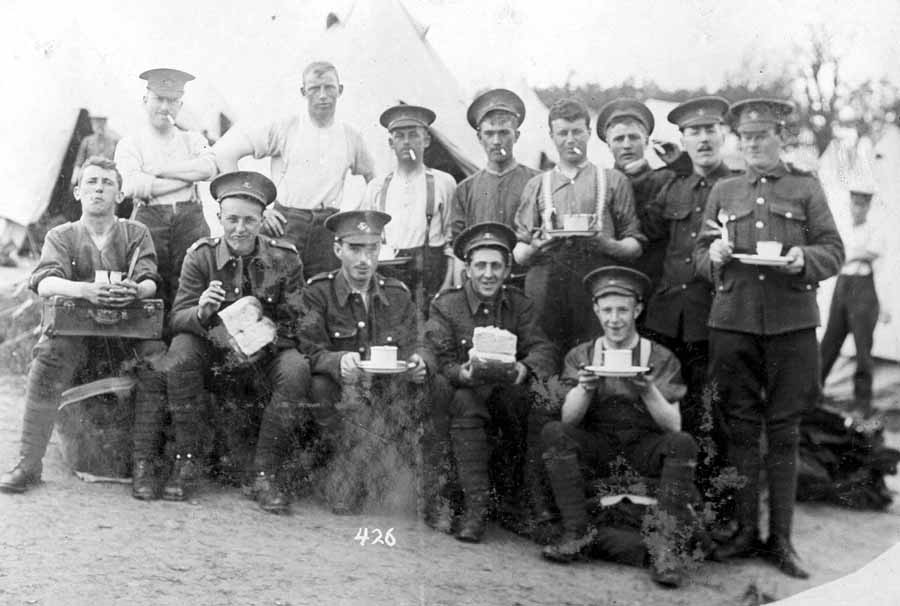
Newfoundland Regiment soldiers, 1915. Newfoundland Regiment soldiers preparing for a meal. Soldiers are holding articles from their mess kit; one is holding a loaf of bread. Courtesy of The Rooms Provincial Archives Division (VA 40-21.4), St. John’s, NL.
In recognition of the Regiment’s exceptional display of honour and courage, King George V bestowed upon the Regiment the prefix of “Royal” in December of 1917. The Newfoundland Regiment was the only regiment granted the designation while hostilities were still occurring in the First World War. The unit was officially disbanded in 1919 following the cessation of hostilities, however the Regiment was resurrected as the primary militia unit for the province upon joining Canadian Confederation in 1949.
While Canada Day is a time of national celebration, it is also a date which invites a reflection on the past. Hundreds of thousands of soldiers paid the ultimate sacrifice in defence of freedom in some of the most brutal conflicts of the twentieth century, and the story of the Newfoundland Regiment and countless other soldiers at Beaumont-Hamel is one such example of tragedy and sacrifice.
To learn more about the Battle of the Somme, visit our online exhibit here: https://museumvimytojuno.ca/en/articles/somme-offensive
Dispatches from Juno shares all the news, events, and stories from the Juno Beach Centre in France and Canada. Interested in contributing a story to the blog? Email the editor at jbca@junobeach.org.


Leave a Reply