
FAREWELL ARTHUR BRITTON SMITH (1920-2023)

It is with tremendous sorrow that we learned of Arthur Britton “Brit” Smith’s passing on October 28th, 2023, in Kingston, Ontario. The Juno Beach Centre conveys sincere condolences to his loved ones and offers eternal gratitude for Arthur’s military and philanthropic service to Canada.
A. B. Smith was born in Kingston on May 10th, 1920, the son of Cyril Middleton Smith and Edna Madeleine Smith. From an early age, he was fixated on the military. In fact, his military career began on his 15th birthday when he joined Kingston’s 32nd Field Battery, an artillery militia unit. A young Smith was educated in Kingston at Victoria School and Kingston Collegiate and Vocational Institute (KCVI).
When he was of age, Smith followed the advice of his superiors in the militia and enrolled in the Royal Military College (RMC). Less than a year after the war had begun in Europe, he graduated from RMC in 1940, and by August, he was assigned to the 4th Field Regiment RCA, 2nd Canadian Division, based out of England.
After years of training, Smith–a captain–finally reached the front in time for the Normandy campaign, landing in France on July 7th, 1944, a month after D-Day. Later that month, the 24-year-old saw his first bit of action as a forward observation officer (FOO) attached to a Les Fusiliers Mont-Royal (FMR) infantry company. FOOs were essential to infantry units as they were responsible for siccing the Allied howitzers upon opposing forces. This battle assignment was perilous as it made Smith and his colleagues targets for German snipers.

A Universal Carrier of the 4th Field Regiment, Royal Canadian Artillery (R.C.A.), Vaucelles, France, 18 or 20 July 1944 (Lieut. Ken Bell / DND / LAC / PA-153423).
On July 20th, Captain Smith orchestrated a creeping barrage so that the FMR could conduct a difficult two-kilometre advance aimed at destroying enemy positions at Troteval Farm south of Caen, France. Smith sprung into action, dividing his energies between identifying targets and coordinating the defence of the Canadian positions. However, it was during this action that he was wounded twice in rapid succession. First, a grenade landed near his position, injuring him slightly. In pursuit of his assailant, Smith was hit by a machine gun. Fortunately, the rounds hit his primitive plastic body armour and thus prevented fatal injury. The Canadian advance proved successful and the farm was captured.
The next day, on the 21st of July, the fighting became even more ferocious. Smith and the troops at Troteval Farm found themselves under attack on five occasions as the Germans attempted to dislodge the Canadians with infantry, armour, and artillery. Nonetheless, Captain Smith accurately directed the ire of 24 guns on the opposing forces, resulting in a staggering 600 rounds fired in a single day. Between radio calls, he fought the enemy with his rifle. Outgunned, surrounded, and down to 17 defenders, the FMR company commander called for a withdrawal, authorizing Smith to call an artillery barrage on their position to cover the retreat from the farmyard. During the escape, machine gun rounds pierced Smith’s Universal Carrier as he and his team pulled back to his regiment’s position.
After this ordeal, Captain Smith was awarded the Military Cross (MC) for “coolness and bravery under heavy fire as well as his complete disregard for his own safety.”
Just four days later, his carrier was disabled by an anti-tank mine. Smith managed to crawl away from the wreck, but he was shot in the head. Miraculously, he was rescued before bleeding out. Smith’s war was short, yet he had distinguished himself as a formidable warrior and leader.
Three weeks after arriving in France, he crossed the English Channel a second time but, this time, upon a stretcher as one of the 1,500 Canadian casualties from the assault on Verrières Ridge. Due to his injuries, Captain Smith returned to Kingston. With the war behind him, he married Sally Carruthers and followed in his father’s footsteps, graduating from Osgoode Hall Law School in 1948. Smith would go on to practice law in Kingston for over 50 years.
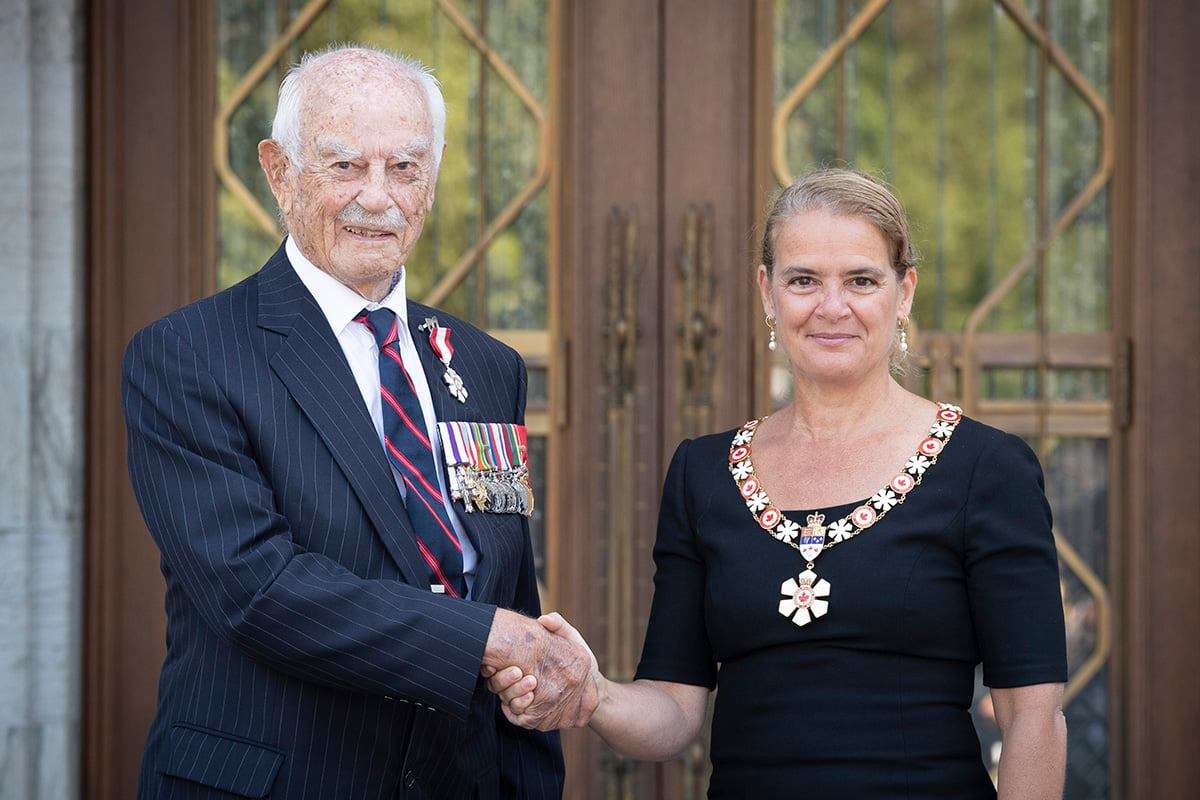
A. B. Smith (Left) poses with former Governor General of Canada, Julie Payette (Right), after recieving his Order of Canada in 2019.
Though focused primarily on law, Smith also invested his time in real estate as a “hobby.” Incredibly, he constructed his first apartment building, an eight-unit low-rise, while he was still a student at Osgoode Hall. In 1954, Smith incorporated his real-estate business–Homestead Land Holdings Ltd. Presently, the company owns 26,000 apartment units in 16 Ontario cities and a single high-rise in Calgary, Alberta. In Kingston alone, Homestead Land Holdings Ltd. owns 44 buildings.
Over eight decades, Smith built one of the largest apartment rental companies in Canada and shared his fortune via the Smith-Homestead Foundation with dozens of charities and institutions such as Queen’s University’s medical and nursing schools, Royal Military College, St. Lawrence College, the United Way, Marine Museum of the Great Lakes, Home Base Housing, and the Kingston General Hospital.
A. B. Smith was both a prolific philanthropist and a selfless member of the Kingston community. In the postwar period, he re-joined the military, enrolling in the local Prince of Wales’ Own Regiment, an infantry militia unit, eventually becoming its honourary colonel. Also, he was the chairman and honourary patron of the United Way campaign for several years, the president of the Frontenac Bar Association, and a life member of many other organizations. Moreover, he served three terms on the city council in the 1950s as an Alderman, using his wealth and influence to ensure the completion of countless community projects. In 2019, Smith was named to the Order of Canada.
Smith was predeceased by his parents, his wife of 68 years, Sally (nee Edith Carruthers), and his son Britton Carruthers (wife Dianna); he leaves his daughter Sheila Bayne (husband Donald); son Alexander (wife Bonnie); many grandchildren and great-grandchildren; his sisters Gwen Berry, Cynthia Hurst; and his partner, Margaret Daicar. Presently, Captain Smith is commemorated on a brick that bears his name and rank at the Juno Beach Centre in Courseulles-sur-Mer, France.

His brick is one of thousands at the Juno Beach Centre. This commemorative and fundraising program helps the JBC continue its mission to preserve the legacy of Canadian service and sacrifice in the Second World War. We will never forget those who led from the front fighting to ensure their children and future generations would inherit a better world.
Furthermore, we would like to thank Sheila Bayne, A.B. Smith’s daughter, who made a donation to support our Faces of Canada Today exhibition renewal project earlier this year. This exhibition will cover how modern Canada emerged from the Second World War thanks in part to the efforts of Veterans like Smith.
Captain (Ret’d) Arthur Britton Smith CM, OOnt, MC, CD, KC will forever have our utmost respect. We send our deepest condolences to Arthur’s family and friends. Thank you for your service, Arthur. We will remember.

Dispatches from Juno shares all the news, events, and stories from the Juno Beach Centre in France and Canada. Interested in contributing a story to the blog? Email the editor at jbca@junobeach.org.

Leave a Reply