
Dispatches
Remembering the Royal Winnipeg Rifles
On June 6th, 1964, the Royal Winnipeg Rifles Monument was erected in Courseulles-sur-Mer, a landing point for Canadian troops along the coast of Normandy 20 years earlier. The monument commemorates the service of the Royal Winnipeg Rifles (nicknamed the Little Black Devils), a Primary Reserve infantry unit of the Canadian Army based out of Minto Armoury in Winnipeg, Manitoba. As part of the 7th Canadian Infantry Brigade, 3rd Canadian Infantry Division, the RWRs were among the first Allied troops to land along the northern coast of France on D-Day, June 6th, 1944, and participated throughout the Normandy campaign, fighting in numerous battles including those at Caen and the Falaise Gap.
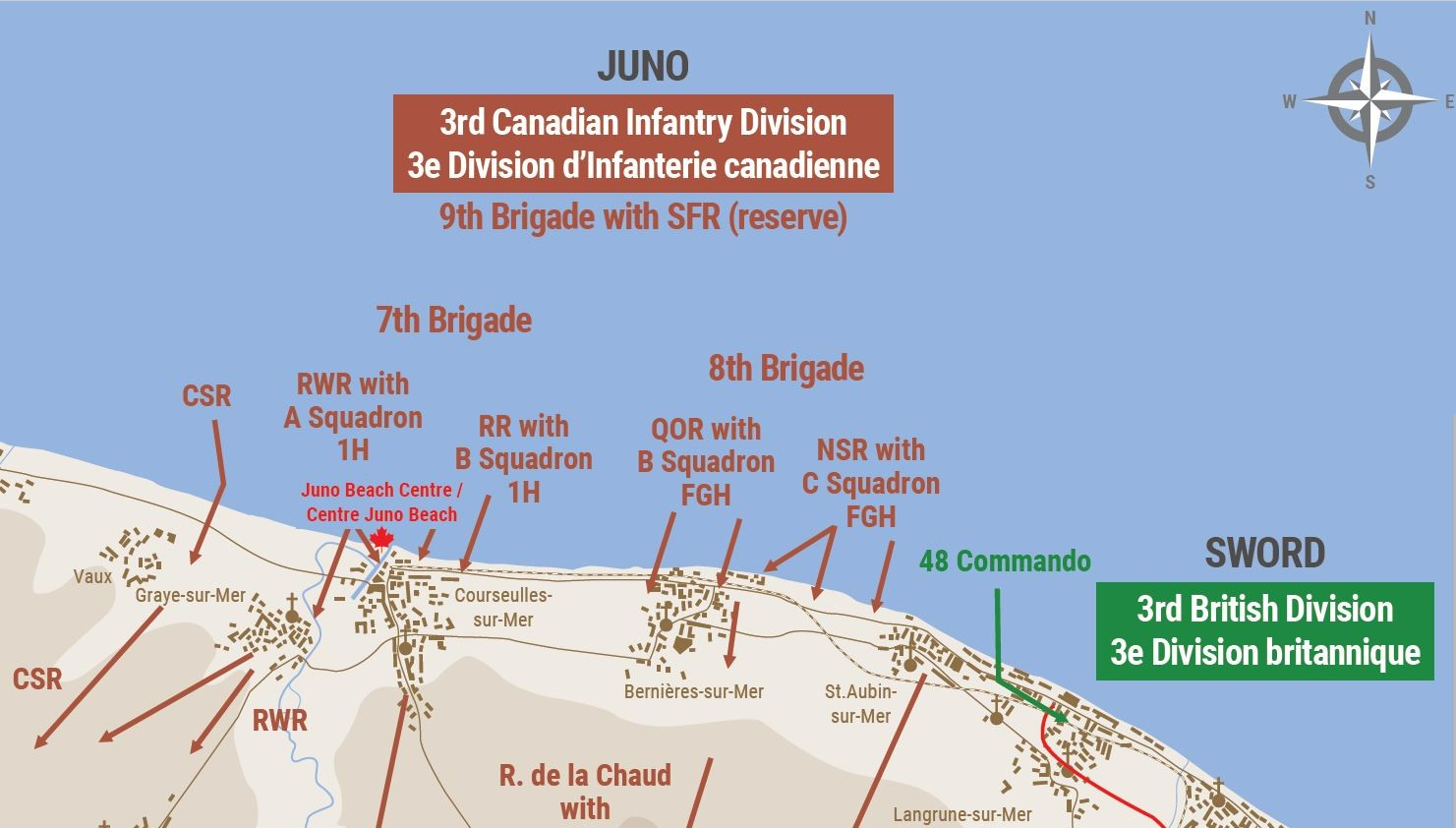
The heroism and sacrifice of the RWRs has been immortalized in the construction of the monument at Courseulles-sur-Mer, but local residents – and Canadian visitors following in the footsteps of the troops who fought for France’s liberation in 1944 – have wondered about the monument’s symbolism, and the reason for its specific location. Indeed, the RWRs came ashore closer to Graye-sur-Mer, which sits approximately a kilometer west of Courseulles-sur-Mer, and while there is now a memorial dedicated to the RWRs at their initial landing location, this was only established years later. The original monument’s design has also been the subject of inquiry; it takes the shape of a downturned sword, which does not immediately seem to relate to the regiment in any significant way.
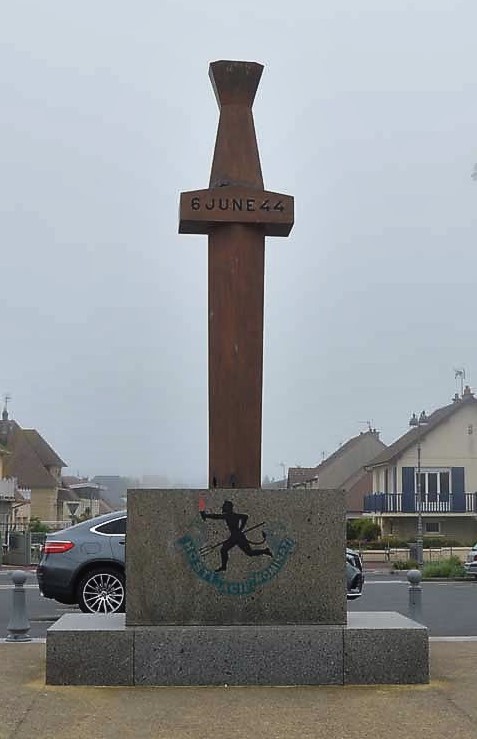
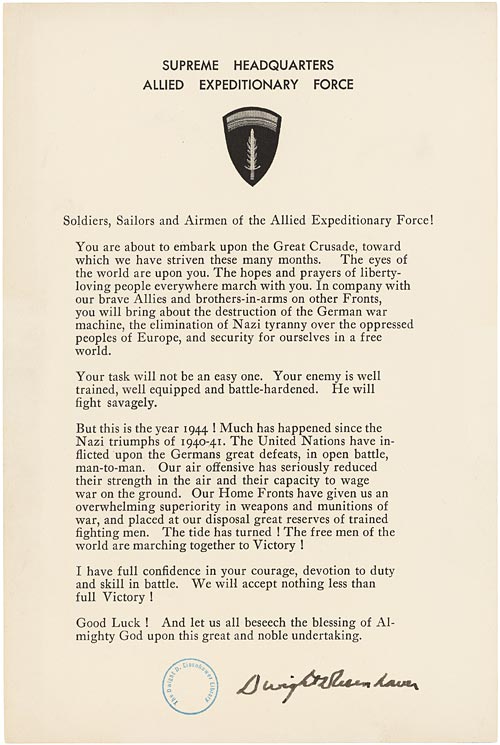
New light has been shed on the monument’s history and symbolic meaning by Lieutenant Colonel (Ret’d) Brian Batter, the son of the monument’s co-designer, Major J. Wally Batter. Brian clarified that the monument is meant to depict a teak crusaders’ sword, which was most likely chosen to represent the regiment because of General Eisenhower’s Order of the Day, which addressed the soldiers, sailors, and airmen of the Allied Expeditionary Force to initiate the events of D-Day. The order commenced with the words: “You are about to embark upon the Great Crusade, toward which we have striven these many months.” Eisenhower also published Crusade in Europe in 1948, and the TV series of the same title aired in 1949. The monument at Courseulles-sur-Mer thus reflects Eisenhower’s words, and the imagery that was being used to depict the troops landing on the shores of Normandy in 1944 – the Royal Winnipeg Rifles among them.
The positioning of the sword likewise bears significance; it is inverted, plunging into a base of Manitoba granite. Brian speculates that the sword was inverted to signify that the battle was over and won, as opposed to being upraised and going into battle. Another interesting aspect of the monument’s design is the rampant devil engraved into the granite base of the monument, a representation of the RWRs’ nickname, arm raised and carrying a torch in hand. However, the devil should be carrying a chalice, not a torch – a mistake that has been acknowledged by the Royal Winnipeg Rifles Senate.
When asked about the monument’s location, Brian states that to his understanding, the monument was not constructed near where the Royal Winnipeg Rifles landed because the ground, particularly near where the RWRs’ B Company landed, was unsound in the 60s due to drainage. Several D-Day veterans have likewise attested that the ground was swampy in the area where they would have liked to put the monument. Although Brian is not yet certain why the current location was chosen, we do know only why the B Company landing place was not chosen.
The RWR Memorial in Courseulles-sur-Mer not only reminds us of the heroism of the soldiers who fought for Allied victory on June 6th, 1944, but also relates, if only in some fragmentary way, what the RWRs might have experienced during their D-Day landing. From the rhetorical impact of Eisenhower’s Order to the swampy conditions that they underwent near Graye-sur-Mer, this landmark serves as a time capsule that preserves the unique history of the Royal Winnipeg Rifles, and is continuing to generate questions and conversation nearly 60 years later.
See more


Donate
to the JBC
As a primarily privately-funded museum, it’s our donors who have made the dream of the Juno Beach Centre a reality.
Learn more about the unique initiatives you can help fund or make a gift to our general fund today to honour the legacy of Canada’s Veterans and ensure their story continues to be told.