
Dispatches
Reflections on the Recent UNESCO World Heritage Listing at Juno Beach

Earlier this summer, the D-Day Landing Beaches were officially inscribed on the UNESCO World Heritage List.
At the end of August, more than 1,000 people gathered at the Juno Beach Centre to celebrate this achievement, along with Region Normandie.
Nathalie Worthington, the Centre’s director, was joined by Chris LaBossiere, president of the Juno Beach Centre Association in Canada, at the event. They offered the following reflections:
With the inscription of the Normandy D-Day landing beaches on the UNESCO World Heritage List, we move beyond seeing them simply as “historic sites of the D-Day landings” to recognizing them as World Heritage sites whose significance transcends national and military histories, carrying a universal message of peace and freedom.
At a time when the prospects for peace and democracy around the world appear increasingly uncertain, and when the values of freedom, equality, and fraternity are being challenged, this inscription offers a message of hope.
The inscription also gives renewed legitimacy to the work of museums and memorial institutions: to explain the Second World War, the D-Day landings and their consequences, but also to explore their contemporary meaning and to embrace a renewed collective responsibility to pass this history on to future generations.
– Nathalie Worthington, Director, Juno Beach Centre
Reflections from Juno Beach
UNESCO, Friendship, and the Promise of Project Concordia
By Chris LaBossiere | President of the Board of Directors, Juno Beach Centre Association
When the announcement arrived that the D-Day landing beaches had been inscribed on the UNESCO World Heritage List, I will admit I did not fully grasp the weight of what that meant.
I have stood on Juno Beach many times over the years, almost always in the solemn embrace of official remembrance. But this visit, under the warm summer sun, felt profoundly different.
Tucked into the dunes, the intimate marks of sacrifice were as poignant as ever: scallop pilgrimage shells planted in the sand, Canadian flags fluttering in the breeze, and a wooden cross marked with a handwritten note: “DAD xxx.”
Yet all around that sacred ground, the beach was alive. Children were running through the surf, cheering, eating ice cream, and filling the air with laughter. An extraordinarily diverse community of countries, ambassadors, and families had gathered together in peace. For the first time, I felt the modern heartbeat of society thriving directly on a platform of sacrifice. That realization stopped me in my tracks. This joy, this freedom, this everyday life was what our soldiers bought for us.
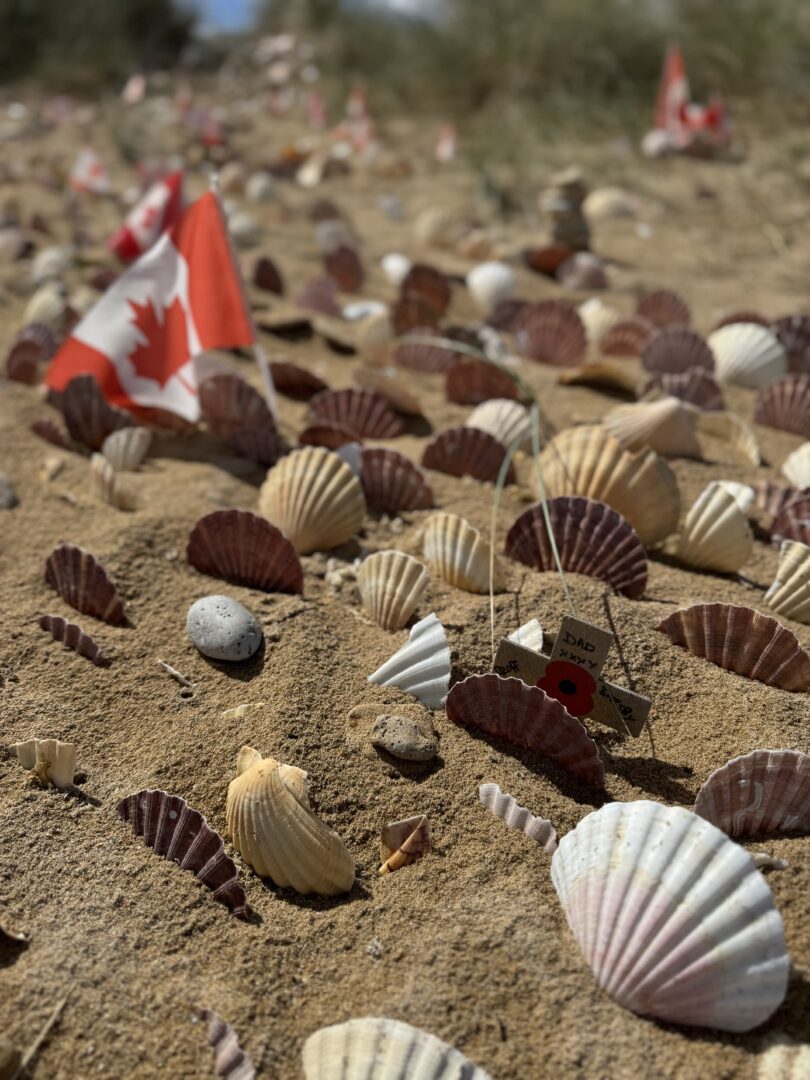
Pilgrimage shells, Canadian flags, and personal tributes on the sands of Juno Beach.
Understanding the multi-decade complexity of this UNESCO inscription was deeply revealing. Bringing together dozens of French municipalities, regional departments, federal bodies, and international allies to protect this coast is a monumental feat of cooperation. Seeing our centre so completely embraced, from the local French townsfolk all the way to global leaders, filled me with a beaming sense of pride. Pride in our people, and pride in Canada.
Out of all five landing beaches, the world chose Juno Beach to host this global milestone. It felt as though the international community tapped Canada on the shoulder. In a world where alliances are shifting, Canada is rising in global reputation as a nation fighting hard to preserve the lessons of World War II and the peace born from them. We earned our seat at that table because we embody collaboration over adversarialism, and because we refuse to forget the 340 Canadians who died on these sands on June 6, 1944.
That sacred coastline was nearly lost. When a controversial condominium development recently threatened this battlefield, Canadians and our French allies rallied in a heroic, expensive battle to protect it. Our French partners stepped up shoulder-to-shoulder with Canada to buy back the land, with the French government, military, and local Normandy communities even contributing direct funding toward what comes next: Project Concordia.
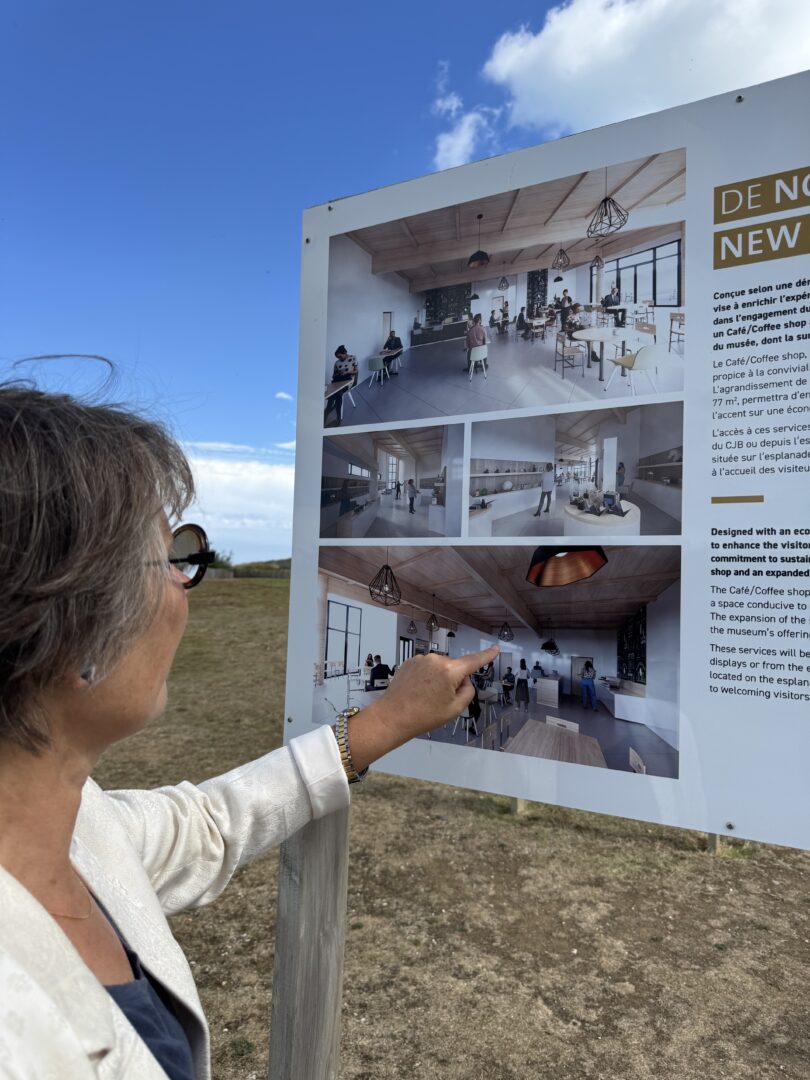
Executive Director Nathalie Worthington reviewing architectural site plans for Project Concordia at the Juno Beach Centre.
On the ground in Courseulles-sur-Mer, this vision has been championed by our extraordinary Executive Director, Nathalie Worthington, and her dedicated team. Nathalie has led with rare grace, ensuring historical remembrance walks hand-in-hand with environmental sustainability and deep local trust across our French host communities.
Through Project Concordia, that rescued land is being transformed into a permanent sanctuary of remembrance, anchored by the first dedicated monument to recognize the 381 Canadians who gave their lives on D-Day.
Back home in Alberta, we talk constantly about infrastructure and pipelines. But standing in Normandy as a 55-year-old Cold War kid, I saw a transatlantic pipeline flowing between Canada and France, carrying shared democratic values, mutual respect, and living memory back and forth across the ocean.
France has shown us what Canadian sacrifice means to them. Not every Canadian can make the pilgrimage to Juno Beach, but together, we can bring that feeling home into our classrooms and communities. We have an inspiring opportunity to stand with our French friends and ensure this ground continues to nurture the peace our soldiers won.
See more


Donate
to the JBC
As a primarily privately-funded museum, it’s our donors who have made the dream of the Juno Beach Centre a reality.
Learn more about the unique initiatives you can help fund or make a gift to our general fund today to honour the legacy of Canada’s Veterans and ensure their story continues to be told.