
Dispatches
Farewell Bill Cameron (1924-2024)
The Juno Beach Centre would like to extend its sincerest condolences to the loved ones and friends of Bill Cameron, who passed on the early morning June 1, 2024, the day he was set to travel to the 80th anniversary of D-Day and Battle of Normandy ceremonies. Bill was 100.
Bill volunteered for the Royal Canadian Navy in 1943, joining in Vancouver aboard HMCS Discovery. He trained on both coasts before joining HMCS Kitchener in January 1944 at Liverpool, Nova Scotia. HMCS Kitchener was one of 20 of the famous Flower-class corvettes deployed by the Royal Canadian Navy (RCN) during Operation Neptune, the naval phase of the Normandy landings, on 6 June 1944. Bill’s was the only Canadian corvette to escort a wave of troops to their disembarkation point that day.
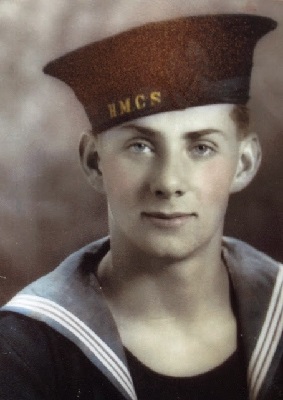
In late April 1944, the Kitchener participated in an anti-submarine exercise in Lough Foyle, off Londonderry, Northern Ireland. After concluding these and other exercises, the corvette arrived off Plymouth, where the American task force was gathering for its part in the D-Day landings. The Kitchener tied up alongside USS Augusta, a Northampton-class cruiser that served as Lieutenant-General Omar N. Bradley’s (1st US Army) headquarters on D-Day.
The Kitchener was initially tasked with escorting two First World War-vintage battleships across the English Channel. The Allies would sink these vintage warships off the Normandy coast to create breakwaters for the Mulberry artificial harbour at Omaha Beach. Bill remembers, “This did not sit very well with our captain or crew, to be going into this kind of battle with these two old ships. So our captain had our duties changed to join in the US Navy escort group, protecting troop landing craft and ships at Omaha Beach.”
The landings at Omaha Beach were tumultuous. The experiences of these assault troops are immortalized in all of their grim details by the opening scene of Saving Private Ryan. Bill recalls observing the situation on the beach through binoculars, “From our vantage point we could see that the soldiers not only had to transit from the barges in questionable water depth along with the Nazi firepower coming from the bluffs above.”
The little Canadian corvette then took up a position to defend the USS Augusta from airborne or underwater attack. Bill remembers that although they often saw bodies floating in the water, orders were not to rescue them. He manned his anti-aircraft gun and fired at any enemy aircraft he identified. “We were all very afraid we would be sunk or killed, but at the same time, we knew we had a job to do. Our skilled captain managed to maneuver our ship such that we did not lose a single man.”
After a busy day, Kitchener escorted USS Augusta back to Plymouth and continued to Milford Haven, Wales. From here, Bill and his shipmates protected ships in the English Channel for the remainder of the war.
Bill Cameron served aboard HMCS Kitchener until May 1945, when the ship returned to Canada. He married in 1949 and visited Normandy for the 70th anniversary of D-Day in 2014 and the 75th in 2019. Bill received the Legion of Honour from the French government in 2015 for his role in the D-Day landings.
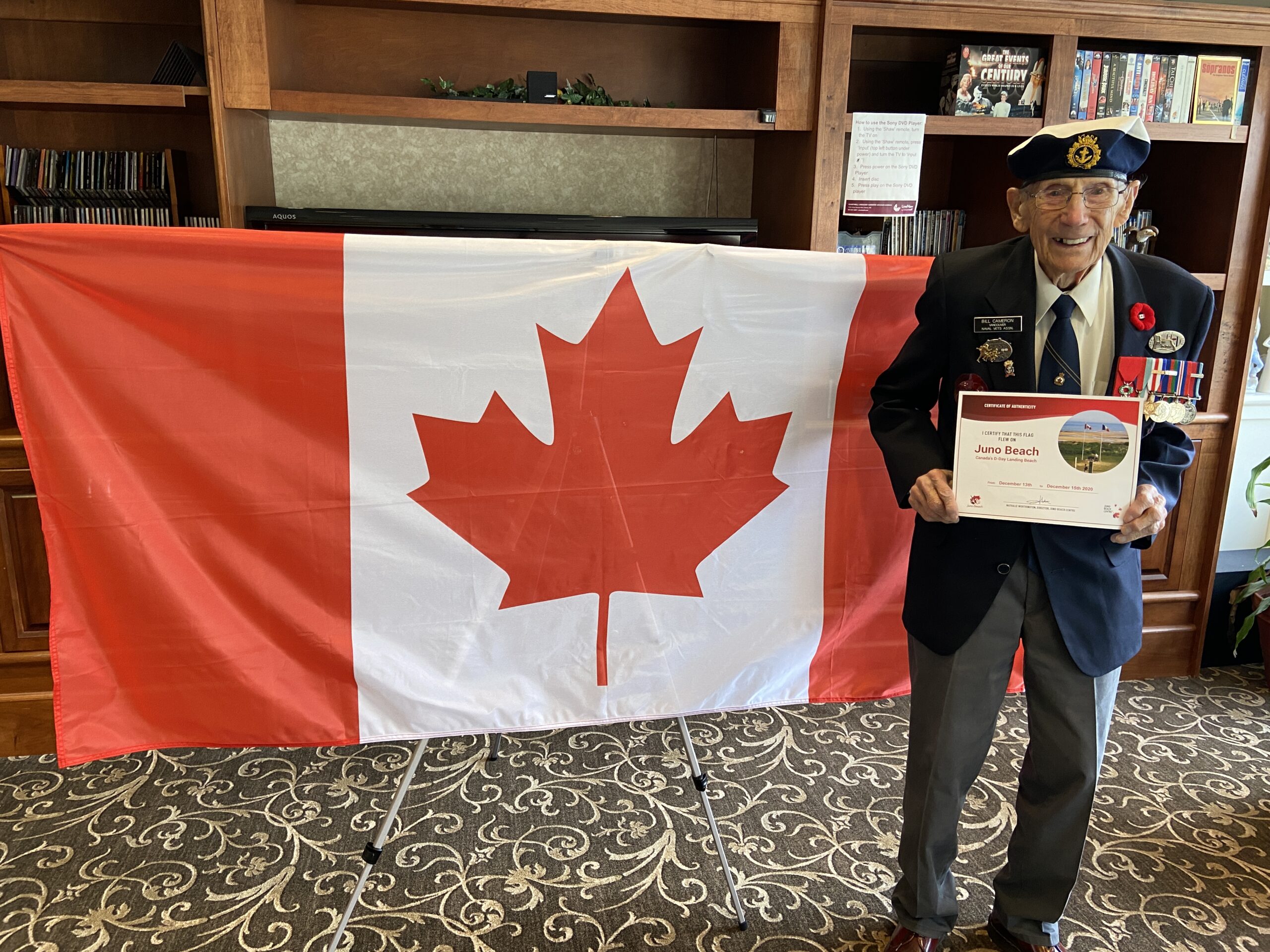
In 2021, the Juno Beach Centre had the honour of presenting a Canadian flag flown on Juno Beach to Bill. His daughter was able to deliver it to him at his retirement residence in Surrey, British Columbia amid the COVID-19 pandemic.
Bill is also one of our featured Legacy of Honour Veterans. You can hear him tell you first-hand about his experiences in the war.
We are eternally grateful for Bill Cameron’s service. We send our deepest condolences to Bill’s family and friends. Thank you for your service, Bill. We will remember.
See more


Donate
to the JBC
As a primarily privately-funded museum, it’s our donors who have made the dream of the Juno Beach Centre a reality.
Learn more about the unique initiatives you can help fund or make a gift to our general fund today to honour the legacy of Canada’s Veterans and ensure their story continues to be told.







