
Dispatches
Commemorating Lieutenant Hugh Baldwin Hall
Very few Second World War veterans’ experiences can neatly begin with a complete biography in the prewar period, followed by a thorough recording of service somewhere between 1939 and 1945, and wrap up with a clear postwar account. In this case, as in the majority, such details remain elusive long after the veteran has passed and even longer after the events themselves occurred. Rarely do we see tales leave the lips of those who bore witness.
Such is the experience of the children of Lieutenant Hugh Balwin Hall, M.C., who, like countless other Canadians, sought to recover the lost knowledge of their father’s military service after his passing. Thus, Hall’s story begins post-1945.
After the war, H. B. Hall resided in Toronto, Ontario, where he married and his wife gave birth to six children. Hall would become a successful businessman, but he spoke little of the war–this was not an uncommon phenomenon for many of his generation. The effects of combat took a substantial toll on his personal life, and his children never broached the subject while he was alive.
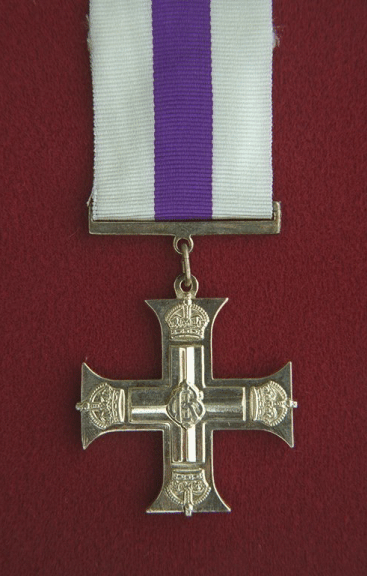
Even so, they remained curious about their dad’s service. Growing up, they had heard whispers of “ . . . motorcycles full of bullet holes and signal lines kept open.” The one thing the Hall family did know for certain was that the famous Field Marshal Bernard Montgomery had awarded their father the prestigious Military Cross (M.C.) at some point during the war.
However, it was not until meeting Cathy Ruch, a descendant of Charles R. Dunk, who was a D-Day survivor and member of the Stormont, Dundas, and Glengarry Highlanders (known commonly as “the Glens” or the “SD&G Highlanders”), and Joe Sullivan, also a D-Day survivor and member of that unit serving in the same platoon as Hall, that the family began to piece together their wartime history.

In tandem with a meetup with then-93-year-old Sullivan, Ruch’s research gave the Hall family a glimpse into the life of a Glen deployed to the European theatre. And Sullivan’s account conveyed the awfulness of war and the immeasurable suffering. He spoke of the shelling, the shooting, the rain, the mud, the carnage, the maimed, and the many “good” people who died—friends, sons, brothers, fathers, and lovers. But amongst all of this, Sullivan shared the prevailing stories of deep friendship and the kind of camaraderie one only develops in times of collective danger—when one’s survival depends on another.
Some of those friendships lasted but a brief stint amid the fighting, while others lasted lifetimes. For the family, Sullivan’s account valuably captured the bond their dad must have forged with the men he served with.
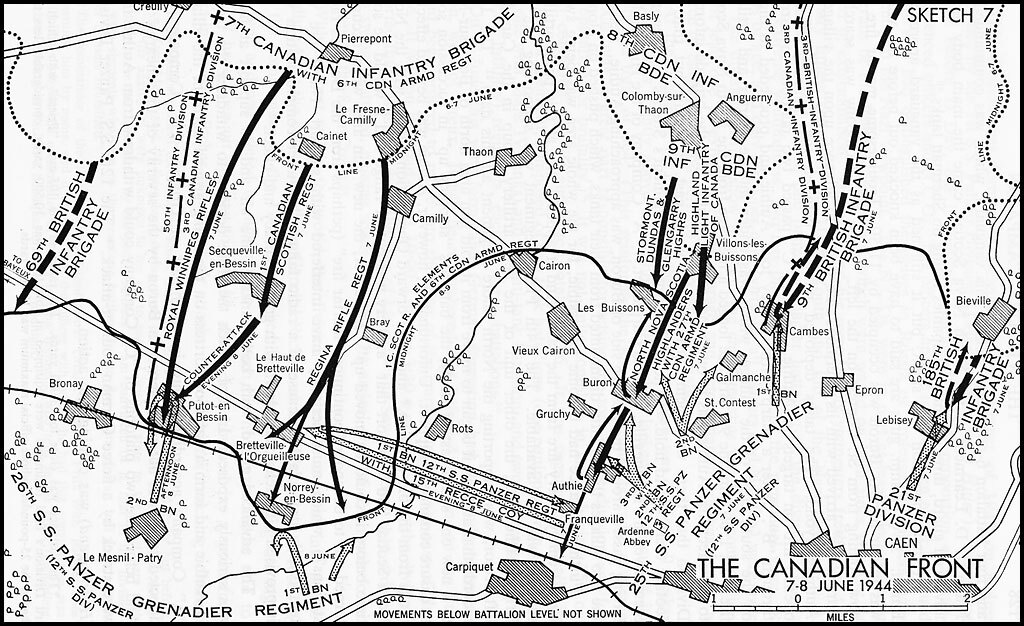
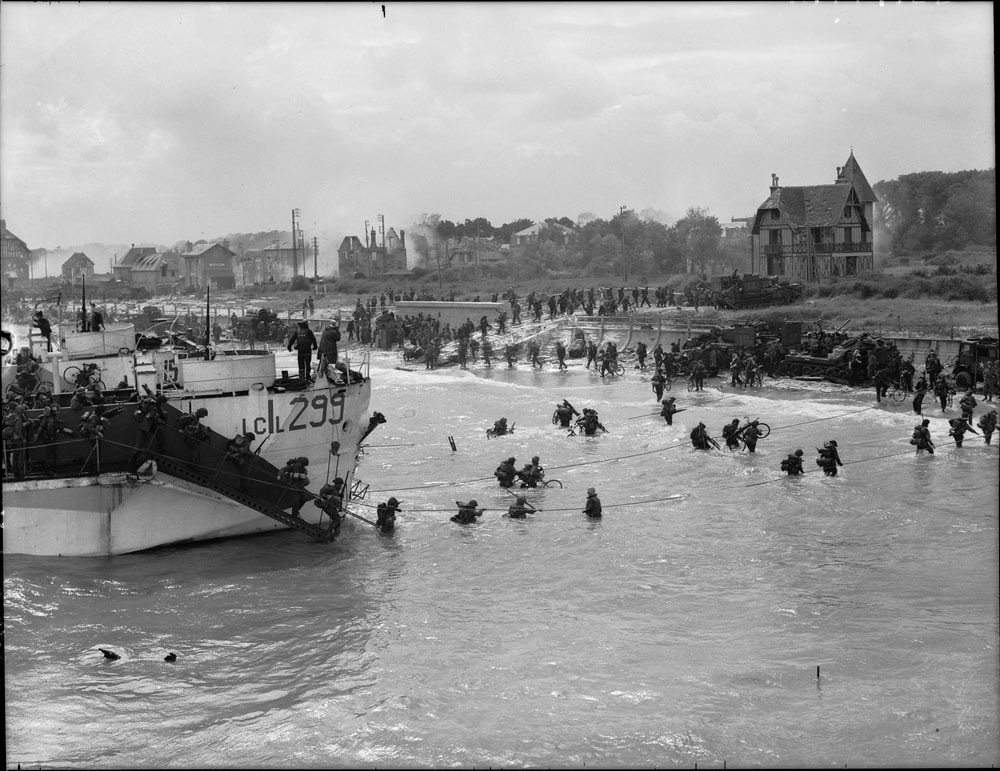
At just 22 years old, H. B. Hall was a junior army officer with the Royal Canadian Corps of Signals in command of the Glens’ signals platoon. The Glens were a unit in the 9th Canadian Infantry Brigade as part of the 3rd Canadian Infantry Division. They had boots on the beaches of Normandy, specifically at White Beach, Bernieres-sur-Mer, France, on June 6th, 1944, at around 12:20 PM.
By this time, much of the action on the beaches had passed; nevertheless, the position was not entirely secure as German forces continued to threaten the advance. Thereafter, the Glens moved inland to Beny-sur-Mer–it was there that they suffered their first combat losses, yet the worst of the fighting was still ahead of them.
The next day, on June 7th, the SD&G Highlanders followed on the coattails of the North Nova Scotia Highlanders, the “Novas,” toward the objective of Carpiquet airfield due west of Caen. There, the Novas met terrific opposition and were forced to fall back on the Glens. The SD&G Highlanders’ Commanding Officer, Lieutenant Colonel G. H. (Christy) Christiansen, consolidated the units at Les Buissons. The Canadians held on with great difficulty, resisting repeated enemy attempts to drive them back into the sea.
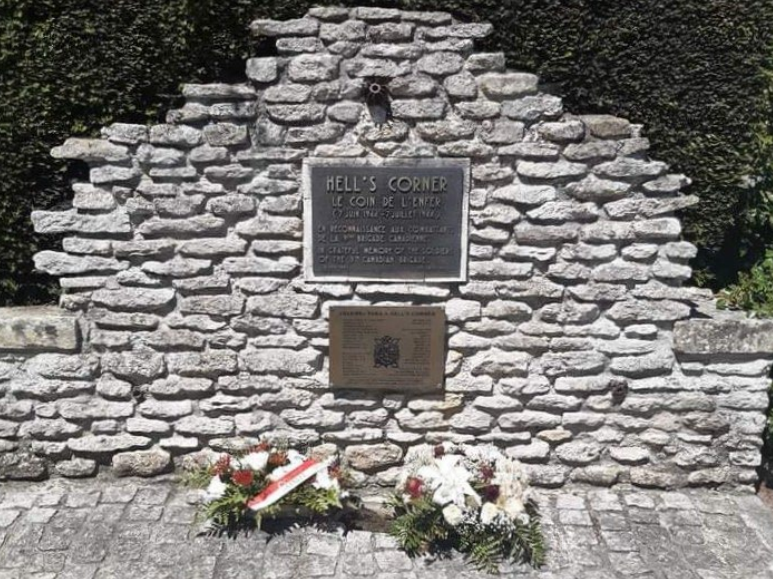
Between June 7th and June 10th, 29 Glens were killed in action and 62 wounded. This position became known as “Hell’s Corner,” and the adjacent street was named “Rue des Glengarrians.” The battalion captured Vieux Cairon, where the SD&G Highlanders remained until July 8th, conducting patrols. It was during this period, commonly known as D-Day plus six, that Lt. Hall distinguished himself as a leader and a warrior.
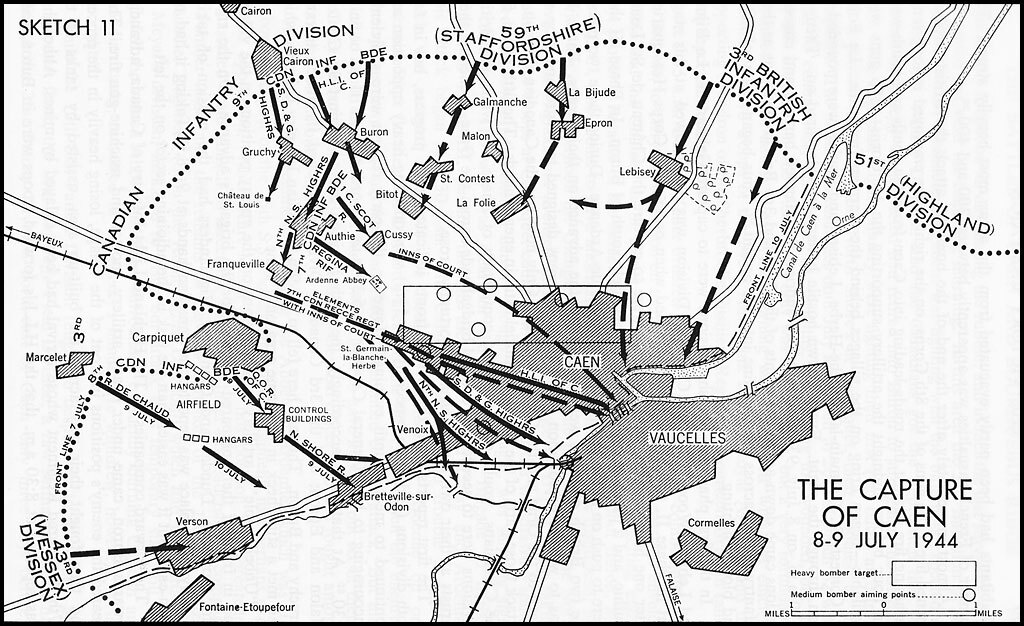
The Glens’ subsequent objectives were Gruchy and a chateau west of that village, followed by the city of Caen, which had been reduced to rubble by Allied naval and air force bombardment.
On July 9th, the battalion became the first Allied group to enter Caen in the early afternoon. Due to the German withdrawal to the south across the River Orne, the city was taken by the end of the day. Still, the Wehrmacht did not relent on Caen, forcing the Canadians who had liberated it to be involved in bloody skirmishes. Ultimately, the 3rd Canadian Infantry Division managed to successfully hold the city via active patrolling, blunting the enemy forces as they attempted to penetrate across the Orne.
By 1945, the Glens had earned an impressive 19 battle honours for actions across North West Europe. And by the war’s end, 3,340 men had served with the battalion. Of those, the regiment suffered 278 killed and 781 wounded.
Although it cannot be confirmed that Hall participated in all of these engagements, it is understood that he landed on the beaches of Normandy in a craft different from Sullivan’s. Therefore, little is known about his D-Day experience, though one could surmise it required a rare kind of courage.
According to the family, following the landings, Hall endured horrible conditions under near-constant enemy fire for 56 days straight. More definitively, Hall’s bravery is immortalized by his actions in the summer of 1944 when he was awarded an M.C. on August 19th. His citation reads:
At Les Buissons and Vieux Cairn [France]. From D day to D plus 6, Lt Hall with almost no rest worked indefatigably to maintain bn [battalion] communications. During this critical and trying period while our posns [positions] were heavily counter-attacked, he maintained our communications by his leadership and courage. On four separate occasions he took signallers out under fire to repair and lay line and on each occasion escaped by a very narrow margin. His coolness steadiness and personal courage inspired his men and were highly important in the success of the bn [battalion] in holding its ground.
The Military Cross is awarded only to Commissioned Officers or Warrant Officers for distinguished, gallant, and commendable services in battle. The medal was established on December 28th, 1914, and Hall makes up one of 3,727 M.C.s that have gone to Canadians since the decoration’s inception.
Although Lieutenant Hugh Baldwin Hall, M.C., passed away decades ago, four of his children visited Normandy in June 2014 to participate in the 70th anniversary
His daughter and former member of Parliament, Martha Hall Findlay, eloquently explained,
We [did] so out of respect for our father, for what he did, for what so many people sacrificed. We hope Dad will be watching and understands . . . We also hope that Canadians will always remember the sacrifices that too many men and women have made; we hope that, in remembering, we have learned from these awful experiences, and that we all work to prevent such damage from ever happening again.
The Juno Beach Centre would like to express its eternal gratitude for Lieutenant Hall’s heroism during the Second World War. We will never forget those who led from the front, such as Hall, fighting to secure a future for succeeding generations to inherit.
Remember Today, Remember Always.
See more


Donate
to the JBC
As a primarily privately-funded museum, it’s our donors who have made the dream of the Juno Beach Centre a reality.
Learn more about the unique initiatives you can help fund or make a gift to our general fund today to honour the legacy of Canada’s Veterans and ensure their story continues to be told.







