Digital Exhbition
1st Canadian Parachute Battalion in the last seven weeks of the war
Written & Researched by Norma Graham
Once we dropped in on Operation Varsity, the battalion had become purely a professional unit…In my opinion, there was none better.
– Lt.-Col. Fraser Eadie, “Victory from Above: First Canadian Parachute Battalion”.
I got out of my parachute harness very quickly. There were bullets flying over my head. The crack past your ears makes you wake up quickly…What we were told was ‘don’t just lay there, get on your feet and do something.’ We were trained to expect this and to do it, so we charged this position and we knocked it out.
– Major Bob Firlotte, “Victory from Above: First Canadian Parachute Battalion”
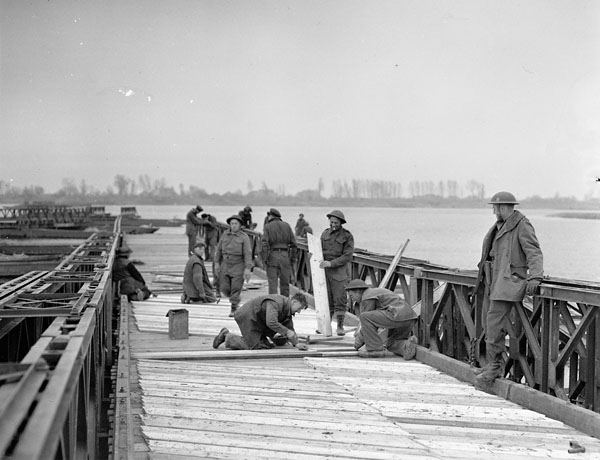
In March of 1945, the Germans were preparing to make a last stand in defense of their homeland. The writing was on the wall, so clear that anyone except Hitler could see it: the Western Allies stood on the western bank of the Rhine, and the Red Army stood menacingly on the eastern side of the Oder. The endgame from the west commenced on March 23, with Operation Plunder.
The purpose of Operation Plunder was to cross the Rhine and create a secure bridgehead that could be widened as the German defences crumbled. The region of Emmerich – Wesel was chosen by the Allied planners due to its location near the Ruhr industrial region, which could then be isolated. It was also good ground both for mechanized warfare and for airborne landings to support the river crossing.
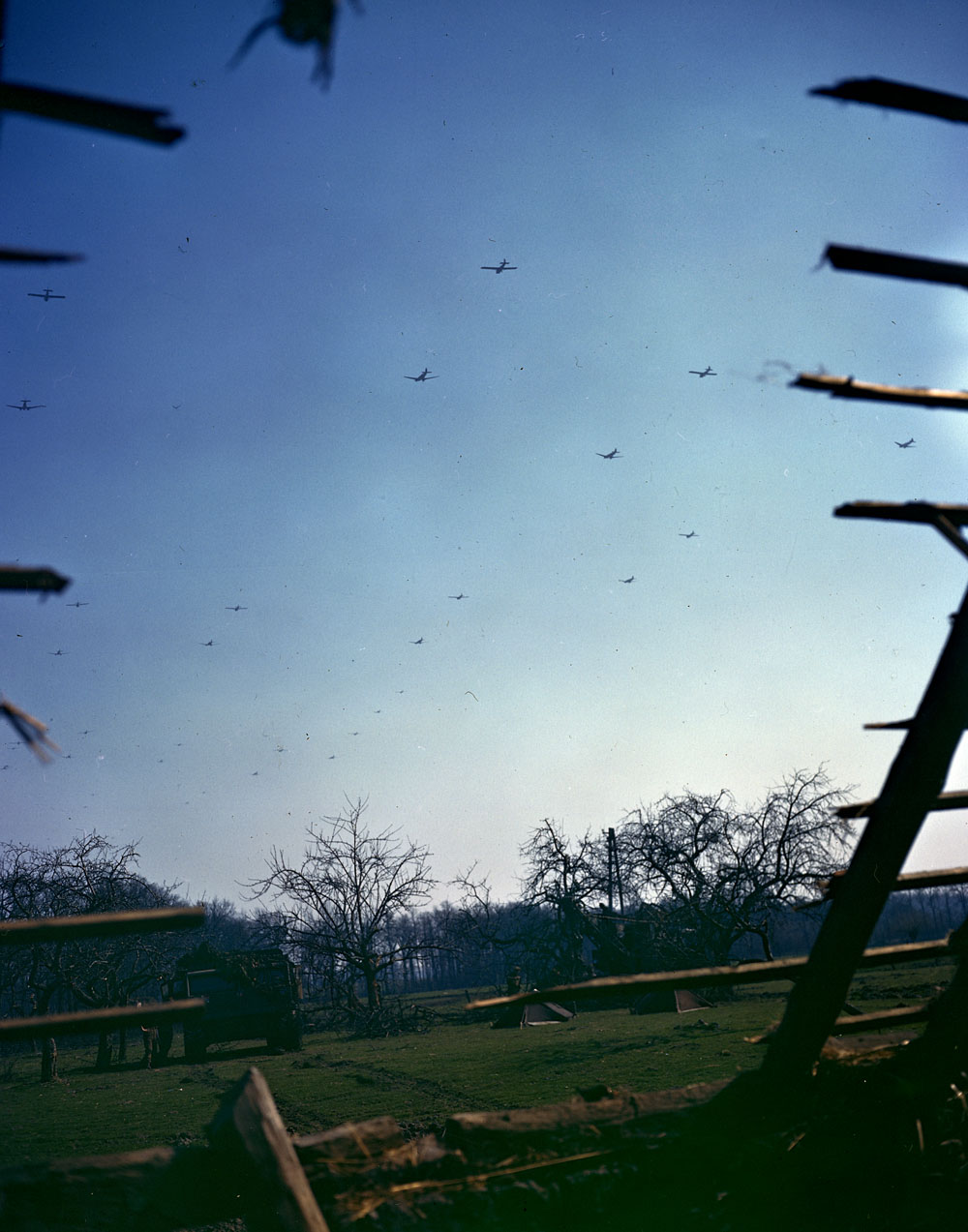
British Second Army under Sir Miles Dempsey was tasked with taking Wesel. This town had a population of about 25,000 in 1939; by the end of the war, repeated bombardments by Allied aircraft and artillery had reduced the town to rubble with only about 1900 people living in the ruins. Dempsey’s army was to be supported by the First Allied Airborne Army, made up of American XVIII Airborne Corps, US 17th Airborne and the British 6th Airborne. Their mission, codenamed Operation Varsity, was to seize key terrain – mostly high ground near the Rhine – to secure the bridgehead and clear the way for Second Army. The airborne troops were to be dropped three to five miles east of the Rhine and north of Wesel. This was to prevent reinforcements from reaching German forces, and to take control of an area of woods and high ground around Diersfordt that could be used by the enemy to camouflage gun positions that would delay Second Army’s breakout.
Specifically, 3rd Parachute Brigade of 6th Airborne, to which 1st Can Para belonged, was to drop first, secure the DZ, then clear the northern area of Diersfordter woods. They were also to seize Schnappenburg Ridge, a daunting task given it was defended by 7th German Fallschirmjäger (parachute) Division. But the enemy guns had to be put out of action to protect the ground troops.
In an unusual turn of events, the airborne troops would be dropped in daytime, after the ground troops had made their first surge across the river Rhine. The hope was that the enemy would be distracted by the ground troops so that the airborne could land at their rear and surprise them. Major-General Eric Bols announced, “Well, gentlemen, you’ll be glad to know that this time we’re not going to be dropped down as a carrot held out for the ground forces. Army and Navy are going to storm across the Rhine, and just when they’ve gained Jerry’s attention in front – bingo! We drop down behind him.”
Timing and placement had to be perfect. Unlike Operation Market Garden, there was to be less than a day’s delay for the airborne and the ground forces to link up. Fortunately, March 24 was a clear sunny day. Commanders were hopeful that a preliminary aerial bombing of the region, along with artillery bombardments, would soften up the German defenses sufficiently that their landing would be, if not unopposed, at least only weakly opposed. But their hopes were dashed. Heavy flak (anti-aircraft fire) from the ground damaged or destroyed several of the transport aircraft. Major Bob Firlotte recalled that he was thrown, rather than jumped, from the Dakota he was in when it was hit by flak. Veterans remembered the coolness and courage of the pilots, who were so determined to drop their men accurately on the Drop Zone (DZ) that they took no evasive action.
As we were approaching the drop zone, we were hit in the right engine and tail section, killing the American Sergeant jump master…The plane was on fire and losing altitude fast…On the way down I was able to see the plane hit the ground and burst into flames.”– Pte. L. H. Hellerud, unpublished manuscript, 1 Can Para Archives, Petawawa, Ontario
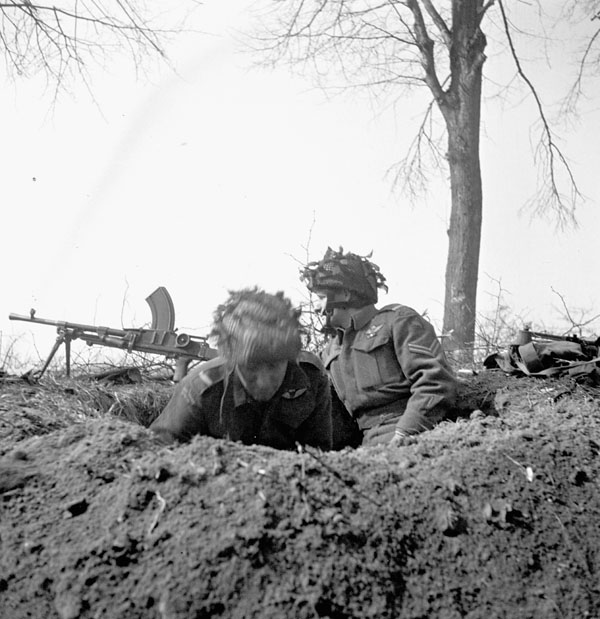
The battalion descended through heavy fire, with many of the men recalling seeing bullet holes in their parachutes as they descended. Major Fraser Eadie, with bullets flying all around him, sagged in his harness, feigning death so the German gunners would direct their fire elsewhere. The landing zone was “hot”, the Germans still determined to hold their ground. Several men lay dead or wounded on the DZ. It was, as expected, chaotic. But the training held firm, with every man displaying initiative and leadership, regardless of rank. This was the ‘secret weapon’ of the parachute battalions: their training was such that they could function effectively in battle whether they had a commanding officer giving them orders or not.For about two hours, there was “flat-out fighting”, until the battalion had taken their objectives. By 1400 hours, enemy resistance had ceased. 24 hours later, the Canadians had linked up with British ground troops.
Operation Varsity was the most successful Allied airborne operation of the war. The hard lessons from Overlord and Market Garden were learned well. The anti-aircraft guns that had been turned on bomber raids heading for the Ruhr were neutralized before they could be redirected at the ground forces making their first major foray into Northern Germany. As with every operation in which they had been involved, 1st Can Para achieved their objectives on time and held them.
1st Can Para had paid a heavy price for this success, however. Sixty-seven out of 475 soldiers were casualties. Their CO, Lt. Col. Jeff Nicklin, was killed at the outset when he came down over a German entrenchment and was riddled with bullets. His body was found still hanging from his parachute that had become entangled in a tree. Fraser Eadie assumed leadership of the battalion and led with courage and resolve to the end of the war. (Since 1946, the Jeff Nicklin Memorial Trophy – donated by the men of 1st Can Para – has been awarded to the best player among the Western teams of the CFL.)A 1st Can Para medic, Corporal Fred “Toppy” Topham, earned the battalion’s only Victoria Cross on March 24. One of 16 VC’s to be awarded to Canadians during the Second World War, the honour was well deserved.

Once the bridgehead was secured, attention was turned to exploiting the gap in the German defences. Eisenhower pulled the U.S. 17th Airborne away from 21st Army Group and sent them southwards with the American 9th Army, so 6th Airborne was attached to British 2nd Army to cross the Elbe river and make for the Baltic.
However, this race for the Baltic was not just military – it had become geopolitical as well. Churchill, warned by diplomatic insiders Averell Harriman and Archie Clark Kerr, foresaw that Stalin would not be held to the Yalta agreements and would seek to impose Communism on all territory taken in eastern Europe. Unfortunately, Roosevelt seemed to still believe that Stalin would stick to the agreement about self-determination of occupied countries. Churchill, who had his faults but certainly knew a threat of tyranny when he saw it, took unilateral action. 6th Airborne – including 1st Can Para – were directed to make with all speed to the Baltic coast city of Wismar. This city had been allocated to the Soviets at Yalta, but its proximity to the Danish border might have been too strong a territorial temptation for Stalin to withstand. Once the Red Army moved in, it was almost impossible to dislodge. Losing Denmark to the Soviets was not a desirable outcome.
In the meantime, they had almost 500 kilometres of enemy-filled territory to cover. They began the advance on 26 March at Issel, then moved the next morning to the village of Burch.
With little resistance encountered there, they moved on to the next objective, a piece of high ground near the village. Ground fog obscured visibility and the men were uneasy. Their discomfiture was justified: a Tiger tank appeared on the roadway. The men fired at the tank from cover and forced it to retreat; but enemy armoured vehicles began firing on them, attempting to stop the Canadians from advancing. Fraser Eadie, now Colonel Eadie, knew the only option to break the obstacle was a frontal assault, but the ground they would have to cover was open and the amount of enemy armour hiding in the woods was unclear. He had no artillery to call on so he would have to make do with the battalion’s own resources: PIAT, mortars, and machine guns.
But then a miracle appeared, in the form of two British jeeps with mounted machine guns. No one knew who they were or where they came from, but they showed up just in time with an offer of assistance which Eadie gratefully accepted. The jeeps flanked the German positions and gave much needed fire support, as well as providing a diversion. The battalion swept through the woods and into the village. The Germans had vanished, as had the British men in the jeeps.
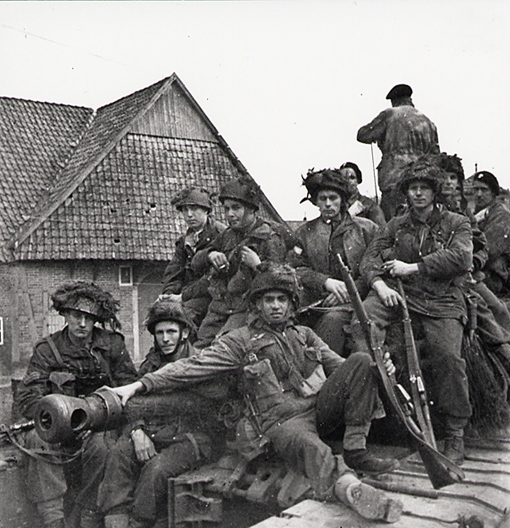
As German defences were mostly focused on guarding the same roads as where 6th Airborne was travelling, there was intermittent fighting, with the town of Lembeck being a particularly tough nut to crack. On March 30, they headed for Greven to seize the bridges over the Dortmund-Ems Canal. They encountered some small arms fire, mostly from Hitler Youth and Volkstrum, but it was dealt with summarily and the paratroopers moved on.
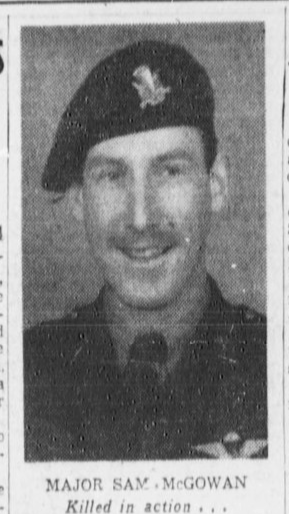
There was a terrible tragedy on March 30, when the much-loved commander of ‘B’ Company, Captain Sam McGowan, was killed. It was not enemy action that killed him; sadly, it was a grenade he was carrying on his belt exploded. It nearly tore him in half. Sergeant Andy Anderson recalled:
We lowered him to the ground, and I held him in my arms, semi-conscious, and he died in that position. This death, and the manner in which it happened has left all the men in the Platoon & Company feeling a great sadness, even though death of friends is an everyday occurrence.
On April 1, after some hard work round the clock by engineers replacing bridges destroyed by the retreating enemy, the crossing of the Dortmund-Ems Canal began. Heavy fire from enemy guns firing air burst shells slowed but did not stop the advance.The battalion next took Ladbergen, defended by German infantry armed with 88-mm guns. Some clever deployment of three platoons of C Company cleared the town. The unit took defensive positions and settled in for a rest. Tired of army rations, the men went scrounging for some fresh food, enjoying a meal of chicken, fresh vegetables, and preserved fruit.
April 3 was another wet day as the men boarded tanks and armoured personnel carriers, headed for Wissingen. By the time they arrived, 9th Parachute Battalion had the place secured after some hard fighting. They headed for the town of Minden late the next day, with 8th Battalion in the lead. A strong enemy force was standing between them and Minden. Brigadier Hill called on Col. Eadie to prepare his men for a night attack with no armoured or artillery support. Fortunately, the enemy soldiers had left the town, and within an hour both 1st Can Para and 8th Battalion were on their objectives. There was a bit of a contretemps with the Americans, related succinctly in the war diary:
A peculiar feature of the day was that MINDEN was an objective of a unit of the 9th American Army, on our right. But our Bde Comd, Brig Hill, DSO, MC pushed on, and took it before they had a chance to do anything about it. The Americans had laid on 350 Fortresses to bomb MINDEN if it hadn’t surrendered by 2000 hrs, but they called it all off when they found our troops in the town.
The Americans took over Minden on April 5th and 1st Can Para continued northeastward, meeting some desultory fighting but nothing they couldn’t handle with ease.
The Germans were pulling back rather rapidly and there was only the odd stray fellow that we would pick up, until we got to the Elbe River and then we started getting prisoners of war, up into the thousands…the Germans were giving up because the Russians were right at their back door, and they knew what would happen if the Russians got ‘em. – Fraser Eadie, interview
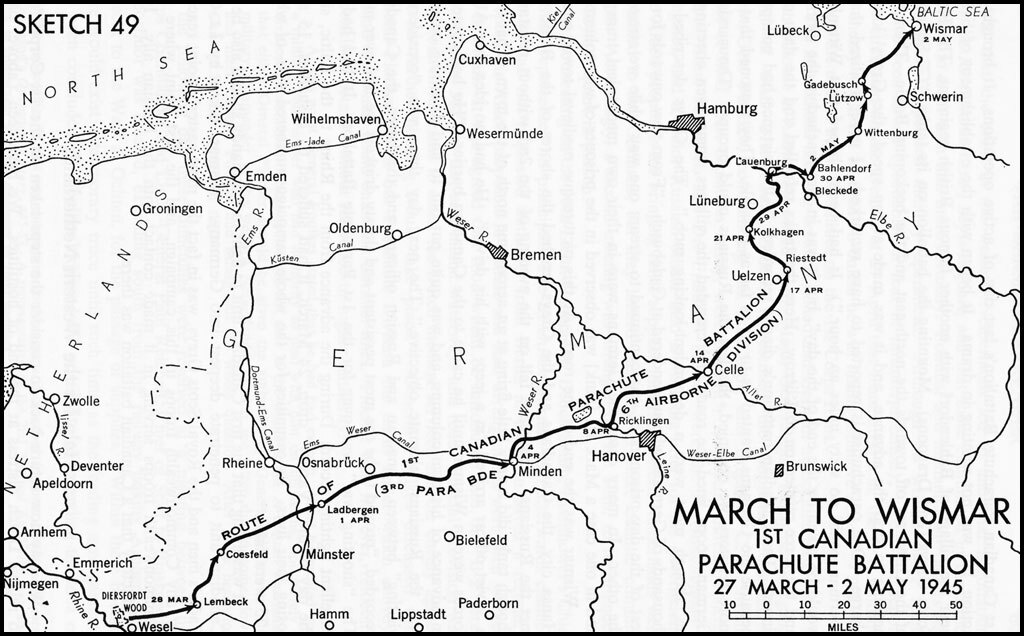
As they continued towards their goal, the number of German POWs they were taking was becoming a problem. They didn’t have the men needed to guard them, food to feed them, or time to question them. This became especially critical when they crossed the Elbe River at the end of April. Not only German soldiers, but German factory workers and their families were streaming by them heading west as the Canadians headed east. Panicked fear of the advancing Red Army drove the Germans on. The men of 1st Can Para just told the soldiers to hand over their weapons and keep walking. Their orders were to get to Wismar before the Soviets, and they were determined to fulfill their orders – especially when Brigadier Hill asked them to spearhead the advance.
The battalion was able to make good time, thanks in part to the tanks of the Royal Scots Greys and RASC troop carriers. One paratrooper joked, “I never realized a Sherman tank could do 60 miles an hour.” That was a bit of an exaggeration, but they traveled 120 kilometres in 12 hours, meeting little resistance. They were astonished at the seemingly endless wave of German units they met who offered nothing but a wave. Lt. Alf Tucker recalled that they drove through a German armoured unit , and “they passed us without doing a thing because they were retreating from the Russians. We went through unit after unit as we drove up”.There was another dust-up with an American unit before the journey to the Baltic ended. Fraser Eadie recalled:
We got up to a place called Gadebusch, where an American armoured regiment decided that they were going to cross our line and take our route up to Wismar. I had the Brigadier with me so I was fairly sure of my ground and I just told the General in charge of that division that he’d better turn them around or the battle was going to start right there. We were going on that route, we were going to Wismar, he was on the wrong route, and he should have been going up the main highway. By God, he backed down, so on we went.”– “Victory from Above: the First Canadian Parachute Battalion”
1st Can Para and the Royal Scots Greys reached Wismar on May 2, only a few hours ahead of the Red Army, and immediately set up roadblocks on the eastern and northeastern sides of the town. They dug in, not knowing how the meeting with the Red Army was going to go – they hoped for the best but they were prepared for the worst. There were still swarms of German troops heading west – Sgt. Andy Anderson recalled that the pile of weapons taken from the German soldiers as they crossed into Allied-held territory was twenty-five feet long and ten feet high.
At 4 pm, C Company which was covering the bridges of the east side of town, met the first Red Army representative, a Soviet officer of the 3rd Tank Corps of the 2nd Belorussian Front commanded by Marshal Konstantin Rokossovsky. “A Russian officer arrived in a jeep with his driver,” noted the battalion war diary, “it was quite unofficial since he had no idea that we were in Wismar until he came to our barrier. He had come far in advance of his own columns and was quite put out to find us sitting on what was the Russians’ ultimate objective”.
Early the next morning, trouble arose at the Canadian roadblock north of town. Sgt. Andy Anderson was awakened by a phone call, telling him that there were Russians wanting to get past the roadblock.
They want into our lines and are being very belligerent and…they seem to be very drunk. My reaction was that they were the hardest looking bunch of toughs I had ever seen. Their uniforms make no sense; they seem to be peasants armed with German weapons. We start to try and converse with them by sign language because our interpreter has not responded to our phone call. They continue to argue; we offer to take the senior ones to HQ under escort, but they want no part of that. What they will settle for is for Pete and I to get in their truck and go back through their lines, but we do not like that proposition. Finally, in some desperation, they give up and disappear back to the Russian lines, wherever that may be. (“The Boys of the Clouds” by Gary C. Boegel)
The next day, Sgt. Anderson and a small group that accompanied him were sent with an interpreter as a patrol to make a friendlier contact. 1st Can Para was blessed with some members who could speak Russian – one of those examples of how being a nation of immigrants was of great benefit. Once the Soviets understood who the Canadians were, there was “handshaking, hugs, and the vodka bottles started to appear”. Anderson and his group did their level best to keep up with the vodka intake, not wishing to give offense; but they ended up passed out, sick, or both. Anderson barely got them back to their own lines before he was violently ill – which probably saved him from a terrible hangover.
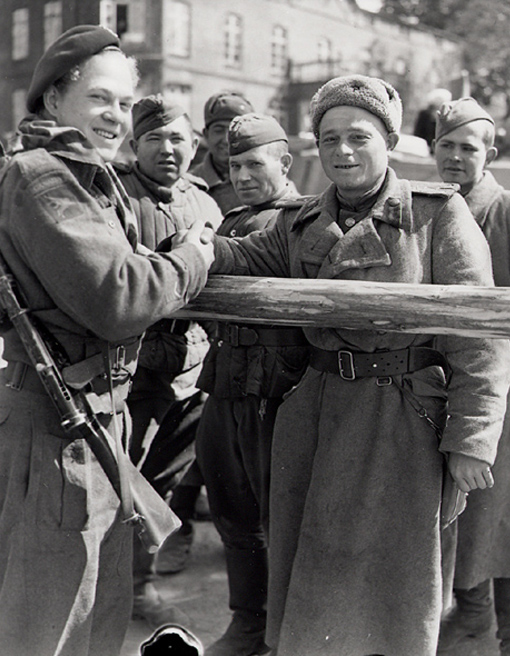
The relationship continued to be unstable. The Soviets insisted on being allowed past Wismar; the Canadians refused to let them through. At one point, an exasperated Col. Fraser Eadie informed an insistent Russian officer, “One of mine can take seven of yours any day of the week, and if you don’t believe me, try it”.
The Canadians did their best to follow the divisional directive: “Dealings with the Russians will be as far as possible governed by a spirit of Friendliness and tolerance, tempered with firmness.” This was easier said than done. Although the Canadians were not allowed past the armed roadblock the Red Army had set up a few dozen yards east of their own – except for one courier jeep per day – the Russians were to be allowed into the city. Russian access to Wismar created nothing but trouble for the Canadians, who were appalled by the behaviour and poor discipline of the Soviets. Andy Anderson recalled:
Although we had been briefed on what to look for in terms of uniform, rank, discipline and so on, we quickly found out that these were largely peasant rabble, terribly undisciplined and determined to get into the city. They at times appeared to be more our enemy than our ally…
Some of the behaviour was atrocious, even criminal. Private A. Carignan recalled that the Russians “would rape every female between 9 and 90 that they could get their hands on”. Sgt. John Feduck remembers patrolling the city to try to protect the terrified citizens from the Russians’ worst excesses:
…these Russians, they were vicious, they would think nothing of molesting women. I was on night patrol, we heard this screaming…I go upstairs and this Russian guy is shooting at this girl…he had most of her clothes off. She was hiding behind a brick chimney and he’d shoot at her if he saw any part of her. So we got him and knocked him out.
There was also the flood of displaced persons flooding into the Allied lines, which was another headache for the Canadian troops. One dark night a few days after they got to Wismar, Major Bob Firlotte was patrolling, when a woman stopped him in the street near a railway siding. Firlotte remembered this event with great emotion:
She said “I have a trainload of women here, we were evacuated from a hospital in Rostock, and most of them are sick and wounded and hurt, and we have no food, the train has run out of fuel. The engineer and all the train crew have left us, our toilets are all plugged up, we are in desperate condition. Can you help?” And I thought, ‘Oh, god, what the hell can I do?’ Anyway, I got some of my men who could drive a vehicle, and back we went. I went down and walked through the train. One woman was laying there dead … some of them were so far gone we had to carry them out of the train. … We got them all to this gymnasium and got them settled. Thank God there was running water. Talk about human misery, you never saw anything like it. They were scared to death of the Russians.– “Victory from Above: the First Canadian Parachute Battalion”
Ultimately, the impasse had to be broken by those higher up the chain of command. On May 7, General Rokossovsky met with Field Marshal Montgomery to discuss a resolution. It was a political decision to default to the Yalta accords, and Wismar was to be surrendered to the Russians. The war against Germany ended on May 8, but the friction at Wismar remained for a few days yet, as the Canadians were tasked with keeping order in the town. John Feduck remembers that “When we were told to leave, [the people of Wismar] begged and cried not to leave them with the Russians”, but there was no choice. On May 19, 1st Can Para and the rest of the 6th Battalion troops left Wismar forever, landing back at Bulford the next night. A few weeks later, they were on their way home to Canada.
Brigadier Hill praised the Canadians for their role in “the fighting trek across…Germany when we more than kept pace with the Armoured Division on our flank which ended with our battalion, the Canadians, entering the town of Wismar on the Baltic Sea 3 hours ahead of the Russians, as Sir Winston Churchill had personally demanded”.
As a primarily privately-funded museum, it’s our donors who have made the dream of the Juno Beach Centre a reality.
Learn more about the unique initiatives you can help fund or make a gift to our general fund today to honour the legacy of Canada’s Veterans and ensure their story continues to be told.