
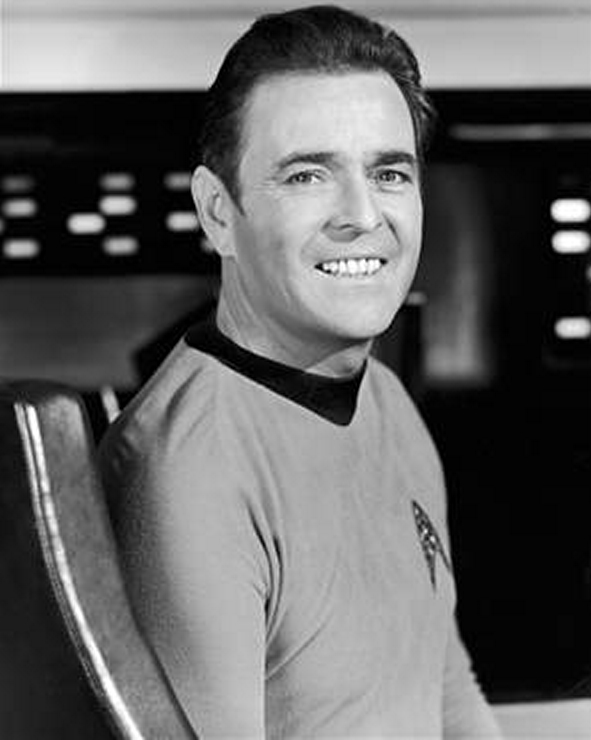
James Doohan

Before he became the most famous Scottish character on television, Lt. James Doohan served in the Canadian Army during the Second World War. Born March 3, 1920 in Vancouver, British Columbia to distinguished Irish immigrant parents (his father claimed to have invented an early form of high-octane gasoline), Doohan’s family later moved to Sarnia, Ontario in his early teens. In school, he excelled in math and science. In 1938, when war seemed imminent, he enrolled in the Army Cadet Corps. A year later he enlisted at the age of twenty as a gunner in the Royal Canadian Artillery (RCA).
Doohan earned his place among the 22nd Field Battery, 13th Field Regiment RCA of the Canadian 3rd Infantry Division. After rising through the ranks to sergeant, he won a place at an Officer Training School, becoming a lieutenant in 1940, and was placed in charge of an entire battery of field guns. He was eventually sent to train in Britain in preparation for Operation Overlord.
His first experience in battle came early in the morning on June 6, 1944. Before dawn, 24 LCTs (Landing Craft Tank) set off towards the beach carrying 96 105mm M7 Priest self-propelled field guns firing in support of destroyers that were pounding the beaches with suppressing fire. Lt. Doohan was a part of the 22nd Battery and at 6:55 am, their guns sundered the silence of dawn as they opened fire against fortified positions in and around the fishing town Courseulles-sur-Mer.
After landing at H+20 on the Mike sector in support of the Royal Winnipeg Rifles and Canadian Scottish, Doohan and his fellow CPOs (Command Post Officers) were pinned down for a short time on the beach by enemy machine gun fire as they struggled to establish firing positions. Once the beach had been secured Doohan’s battery advanced to a concentration area near Banville where the CPO’s met their respective troops and led them to their new gun positions. There they established defensive positions for the night.
That evening, Doohan was hit by machine-gun fire when returning to his command post after enjoying a cigarette; a jumpy Canadian sentry fired on his lieutenant mistaking him for the enemy. Four rounds hit his leg, one passed through his right middle finger and one hit him in the chest, deflecting off the lucky cigarette case given to him by his brother. Later, his right middle finger would have to be amputated, an injury he would often conceal on-screen throughout his career.
After convalescing in England, he graduated as an air observation pilot and flew Taylorcraft Auster Mark V aircraft for 666 Squadron, RCAF. The work of air observation pilots was dangerous and consisted of low-level flights over enemy positions so that artillery officers could photograph, observe and direct artillery fire from the air. Although 666 Squadron RCAF was not sent into combat, the unit was stationed in Apeldoorn, Holland, through the summer of 1945 to conduct “air taxi” duties. Doohan was once labeled the “craziest pilot in the Canadian Air Force” when in the late spring of 1945, on Salisbury Plain north of Andover, he flew an Auster Mark IV between two telegraph poles just “to prove it could be done”.
During his service, Doohan often fraternized with Scottish troops. He became particularly friendly with some from Aberdeen, and later said this is what inspired Montgomery Scott’s accent. He recalled, “I decided to give Scotty an Aberdeen accent, which was something I had learned […] when I was sent over to England during the war. While I was there, I met this fellow from Aberdeen; and I couldn’t understand one word he said! But I did learn that accent from him and that was the one I used for Scotty.”
After the war, he moved to London, Ontario where he worked in radio as a voice actor. By 1946, he had earned several roles on the CBC, making his TV debut on the detective show, Martin Kane, where he appeared in 54 episodes. In his post-war years, it’s estimated that he performed in over 4,000 radio shows and 450 television programs.
Having developed a talent for accents while working in radio, Doohan auditioned for the role of a yet-unnamed Chief Engineer for a show called Star Trek in 1965. During his audition, having tried a number of accents for his character, including German and Italian, the show’s creator Gene Roddenberry asked which he preferred. Doohan replied: “if you want an engineer, in my experience the best engineers are Scotsmen.” James would name the character Montgomery Scott in honor of his grandfather.
Over several generations, many fans have been inspired by Doohan’s character Mr. Scott, among them astronaut Neil Armstrong. Of his experience in the war, Doohan wrote: “I was twenty-four… and if the Germans had been marginally better shots, I wouldn’t have seen twenty-five.”

Sources:
“Battle History 666” (2006) ed. Maj. A.B. Stewart, and in “Canada’s Flying Gunners” (2002), by Col. Dave Fromow.
Barrett, W. W. The history of 13 Canadian Field Regiment, Royal Canadian Artillery, 1940-1945, 1945.
Doohan, James. Beam me up, Scotty: Star Trek’s “Scotty” in his own words. New York: Pocket, 1996.
“Star Trek Ace is a Former Pilot”. 1968. Vol. B-12. Pennsylvania: Beaver County Times.
Wynn, Anthony. Conversations at Warp Speed. Duncan, OK: BearManor Media, 2012.
By Jordan Strate